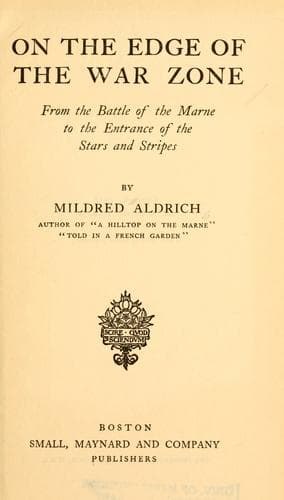
On the Edge of the War Zone: From the Battle of the Marne to the Entrance of the Stars and StripesAldrich, Mildred
History
On the Edge of the War Zone: From the Battle of the Marne to the Entrance of the Stars and Stripes
Aldrich, Mildred
World War, 1914-1918 -- Personal narratives
"Why don't you go home?"
"This is my home."
"Haven't you any home in America?"
I resisted telling him that it was none of his business, and did my best
to look pathetic--it was that, or laugh--as I answered: "Alas! I have
not."
This seemed to strike both of them as unbelievable, and they only
stared at me as if trying to put me out of countenance.
In the meantime, some of the people of Huiry, interested always in
gendarmes, were standing at the top of the hill watching the scene,
so I said: "Suppose you come inside and I will answer your questions
there," and I opened the door of the salon, and went in.
They hesitated a moment, but decided to follow me. They stood, very
stiffly, just inside the door, looking about with curiosity. I sat down at
my desk, and made a motion to them to be seated. I did not know
whether or not it was correct to ask gendarmes to sit down, but I
ventured it. Evidently it was not correct, for they paid no attention to
my gesture.
When they were done looking about, they asked me for my papers.
I produced my American passport. They looked at the huge steel-
engraved document with great seriousness. I am sure they had never
seen one before. It impressed them--as well it might, in comparison
with the civil papers of the French government.
They satisfied themselves that the picture affixed was really I--that the
name agreed with that on their books. Of course, they could not read
a word of it, but they looked wise. Then they asked me for my French
papers. I produced my permis de séjour--permitting me to stay in
France provided I did not change my residence, and to which was
affixed the same photograph as that on my passport; my declaration
of my civil situation, duly stamped; and my "immatriculation," a leaf
from the register on which all foreigners are written down, just as we
would be if admitted to a hospital or an insane asylum.
The two men put their heads together over these documents--
examined the signatures and the seals with great gravity--with evident
regret to find that I was quite en règle.
Finally they permitted me to put the documents all back in the case in
which I carry them.
I thought the scene was over. Not at all. They waited until I shut the
case, and replaced it in my bag--and then:
"You live alone?" one asked.
I owned that I did.
"But why?"
"Well," I replied, "because I have no family here."
"You have no domestic?"
I explained that I had a femme de ménage.
"Where is she?"
I said that at that moment she was probably at Couilly, but that
ordinarily when she was not here, she was at her own home.
"Where is that?" was the next question.
So I took them out on to the terrace again, and showed them
Amélie's house.
They stared solemnly at it, as if they had never seen it before, and
then one of them turned on me quickly, as if to startle me. "Vous êtes
une femme de lettres?"
"It is so written down in my papers," I replied.
"Journaliste?"
Public-domain text, read in full here on John Shaqi.
Reviews
Reviews
No reviews yet
Be the first to share your thoughts on this work.
Join the Discussion
Join the discussion
Sign in to leave a comment or review.
Sign InorCreate an account