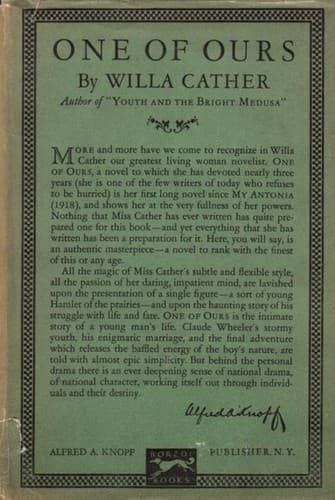
Farm life -- Fiction; Nebraska -- Fiction; Soldiers -- Fiction; War stories; World War, 1914-1918 -- Fiction
She hesitated and bent lower. "He asked me fur them pickled
peaches I made fur you, but I didn't give him none. I hid 'em all
in my old cook-stove we done put down cellar when Mr. Ralph
bought the new one. I didn't give him your mudder's new
preserves, nudder. I give him the old last year's stuff we had
left over, and now you an' your mudder'll have plenty." Claude
laughed. "Oh, I don't care if Ralph takes all the fruit on the
place, Mahailey!"
She shrank back a little, saying confusedly, "No, I know you
don't, Mr. Claude. I know you don't."
"I surely ought not to take it out on her," Claude thought, when
he saw her disappointment. He rose and patted her on the back.
"That's all right, Mahailey. Thank you for saving the peaches,
anyhow."
She shook her finger at him. "Don't you let on!"
He promised, and watched her slipping back over the zigzag path
up the hill.
XIV
Ralph and his father moved to the new ranch the last of August,
and Mr. Wheeler wrote back that late in the fall he meant to ship
a carload of grass steers to the home farm to be fattened during
the winter. This, Claude saw, would mean a need for fodder. There
was a fifty-acre corn field west of the creek,--just on the
sky-line when one looked out from the west windows of the house.
Claude decided to put this field into winter wheat, and early in
September he began to cut and bind the corn that stood upon it
for fodder. As soon as the corn was gathered, he would plough up
the ground, and drill in the wheat when he planted the other
wheat fields.
This was Claude's first innovation, and it did not meet with
approval. When Bayliss came out to spend Sunday with his mother,
he asked her what Claude thought he was doing, anyhow. If he
wanted to change the crop on that field, why didn't he plant oats
in the spring, and then get into wheat next fall? Cutting fodder
and preparing the ground now, would only hold him back in his
work. When Mr. Wheeler came home for a short visit, he jocosely
referred to that quarter as "Claude's wheat field."
Claude went ahead with what he had undertaken to do, but all
through September he was nervous and apprehensive about the
weather. Heavy rains, if they came, would make him late with his
wheat-planting, and then there would certainly be criticism. In
reality, nobody cared much whether the planting was late or not,
but Claude thought they did, and sometimes in the morning he
awoke in a state of panic because he wasn't getting ahead faster.
He had Dan and one of August Yoeder's four sons to help him, and
he worked early and late. The new field he ploughed and drilled
himself. He put a great deal of young energy into it, and buried
a great deal of discontent in its dark furrows. Day after day he
flung himself upon the land and planted it with what was
fermenting in him, glad to be so tired at night that he could not
think.
Public-domain text, read in full here on John Shaqi.
Reviews
Reviews
No reviews yet
Be the first to share your thoughts on this work.
Join the Discussion
Join the discussion
Sign in to leave a comment or review.
Sign InorCreate an account