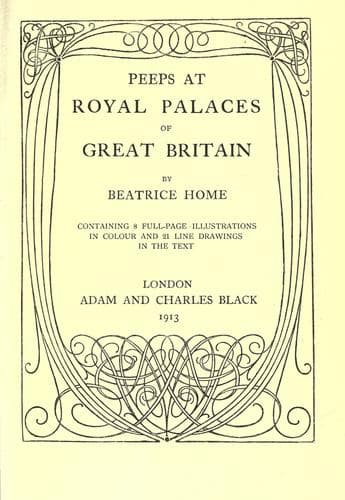
Peeps at Royal Palaces of Great Britain — John Shaqi
Peeps at Royal Palaces of Great BritainHome, Beatrice
History
Peeps at Royal Palaces of Great Britain
Home, Beatrice
Palaces -- Great Britain
So wrote Sir Walter Scott, an opinion which can be endorsed to-day,
enough of the palace remaining, ruined though it is, to show what a
stately and dignified structure it was in its days of greatness. The
palace, standing on some rising ground jutting into a beautiful lake,
is square in construction, having towers at the corners. The original
entrance was on the eastern side, through a gateway which was
protected by a drawbridge. Inside this gateway is a mutilated statue,
thought to represent Pope Julius II., who gave James IV. his sword,
still to be seen among the regalia in Edinburgh Castle. A ruined
fountain stands in the centre of the courtyard, which once resounded
with all the gaiety of the Stuart Court. The western side, containing
the room where Queen Mary was born, is the oldest, while the northern
side is the most recent, being rebuilt by James VI.
Apparently there was a castle or royal manor-house at Linlithgow from
the time of David I., who granted the skins of the rams, sheep, and
lambs, who died there, to his foundation abbey of Holyrood.
When Edward I. was holding sway over Scotland, he spent a considerable
time at Linlithgow, turning it into a real fortress. Builders, masons,
and carpenters were ordered from England, who threw up stockades,
enclosing the parish church within the walls. It remained in English
hands until 1314, when it was taken by a familiar strategy. A farmer,
named Binnock, who was in the custom of bringing hay to the garrison,
determined to capture the castle, one of the last to submit to the
conquering Scots. One morning he drove up as usual to the castle gate,
stopping his cart immediately under the portcullis, which was raised
to admit him. Cutting the yoke which fastened his horses, so that the
cart could not be shifted nor the portcullis lowered, Binnock sprang
upon the unsuspecting porter and killed him. The hay in the cart
covered some armed men who leapt out, being joined by others concealed
near the gateway. The garrison was completely surprised, and were
all put to the sword. Binnock was rewarded by a grant of land. Bruce
destroyed the castle, following his usual policy, but it must have
been rebuilt some time during the reign of his son.
The palace which now remains is entirely a Stuart building, the older
castle and part of the church having been burnt down the year that
James I. returned to his native country after his long captivity.
Great rebuilding took place in his reign, and, indeed, he is
considered the main builder, the later monarchs only adding to and
adorning portions of his scheme. It was in this new palace that Henry
VI. of England, with Margaret of Anjou, and Edward Prince of Wales,
stayed when the triumph of the Yorkists had driven them from England.
Public-domain text, read in full here on John Shaqi.
Reviews
Reviews
No reviews yet
Be the first to share your thoughts on this work.
Join the Discussion
Join the discussion
Sign in to leave a comment or review.
Sign InorCreate an account