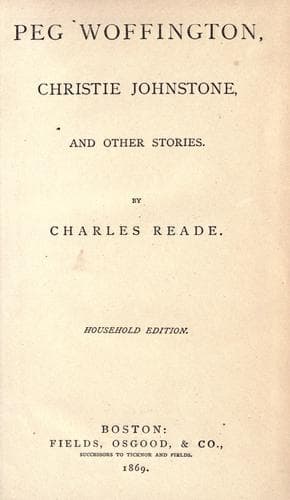
Actresses -- Fiction; Biographical fiction; Great Britain -- History -- 18th century -- Fiction; Woffington, Margaret, -1760 -- Fiction
Lysimachus brought him the fiddle, and Triplet essayed a merry tune; but
it came out so doleful, that he shook his head, and laid the
instrument down. Music must be in the heart, or it will come out of the
fingers--notes, not music.
“No,” said he; “let us be serious and finish this comedy slap off.
Perhaps it hitches because I forgot to invoke the comic muse. She must
be a black-hearted jade, if she doesn't come with merry notions to a
poor devil, starving in the midst of his hungry little ones.”
“We are past help from heathen goddesses,” said the woman. “We must pray
to Heaven to look down upon us and our children.”
The man looked up with a very bad expression on his countenance.
“You forget,” said he sullenly, “our street is very narrow, and the
opposite houses are very high.”
“James!”
“How can Heaven be expected to see what honest folk endure in so dark a
hole as this?” cried the man, fiercely.
“James,” said the woman, with fear and sorrow, “what words are these?”
The man rose and flung his pen upon the floor.
“Have we given honesty a fair trial--yes or no?”
“No!” said the woman, without a moment's hesitation; “not till we die,
as we have lived. Heaven is higher than the sky; children,” said she,
lest perchance her husband's words should have harmed their young souls,
“the sky is above the earth, and heaven is higher than the sky; and
Heaven is just.”
“I suppose it is so,” said the man, a little cowed by her. “Everybody
says so. I think so, at bottom, myself; but I can't see it. I want to
see it, but I can't!” cried he, fiercely. “Have my children offended
Heaven? They will starve--they will die! If I was Heaven, I'd be just,
and send an angel to take these children's part. They cried to me for
bread--I had no bread; so I gave them hard words. The moment I had done
that I knew it was all over. God knows it took a long while to break my
heart; but it is broken at last; quite, quite broken! broken! broken!”
And the poor thing laid his head upon the table, and sobbed, beyond all
power of restraint. The children cried round him, scarce knowing why;
and Mrs. Triplet could only say, “My poor husband!” and prayed and wept
upon the couch where she lay.
It was at this juncture that a lady, who had knocked gently and unheard,
opened the door, and with a light step entered the apartment; but no
sooner had she caught sight of Triplet's anguish, than, saying hastily,
“Stay, I forgot something,” she made as hasty an exit.
This gave Triplet a moment to recover himself; and Mrs. Woffington,
whose lynx eye had comprehended all at a glance, and who had determined
at once what line to take, came flying in again, saying:
“Wasn't somebody inquiring for an angel? Here I am. See, Mr. Triplet;”
and she showed him a note, which said: “Madam, you are an angel. From a
perfect stranger,” explained she; “so it must be true.”
Public-domain text, read in full here on John Shaqi.
Reviews
Reviews
No reviews yet
Be the first to share your thoughts on this work.
Join the Discussion
Join the discussion
Sign in to leave a comment or review.
Sign InorCreate an account