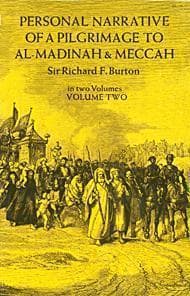
Personal Narrative of a Pilgrimage to Al-Madinah & Meccah — Volume 1Burton, Richard Francis, Sir
ReligionIslamic
Personal Narrative of a Pilgrimage to Al-Madinah & Meccah — Volume 1
Burton, Richard Francis, Sir
Arabian Peninsula -- Description and travel
[p.38]magistrate, or an officer, the very picture of cringing
submissiveness. But after leaving the room, he is as different from his
former self as a counsel in court from a counsel at a concert, a sea
captain at a club dinner from a sea captain on his quarter-deck. Then
he will discover that the English are not brave, nor clever, nor
generous, nor civilised, nor anything but surpassing rogues; that every
official takes bribes, that their manners are utterly offensive, and
that they are rank infidels. Then he will descant complacently upon the
probability of a general Bartholomew's Day in the East, and look
forward to the hour when enlightened Young India will arise and drive
the "foul invader" from the land.[FN#12] Then he will submit his
political opinions nakedly, that India should be wrested from the
Company and given to the Queen, or taken from the Queen and given to
the French. If the Indian has been a European traveller, so much the
worse for you. He has blushed to own,-explaining, however , conquest by
bribery,-that 50,000 Englishmen hold 150,000,000 of his compatriots in
thrall, and for aught you know, republicanism may have become his idol.
He has lost all fear of the white face, and having been accustomed to
unburden his mind in
"The land where, girt by friend or foe,
A man may say the thing he will,"-
he pursues the same course in other lands where it is exceedingly
misplaced. His doctrines of liberty and
[p.39]equality he applies to you personally and practically, by not
rising when you enter or leave the room,-at first you could scarcely
induce him to sit down,-by not offering you his pipe, by turning away
when you address him; in fact, by a variety of similar small affronts
which none knows better to manage skilfully and with almost impalpable
gradations. If-and how he prays for it!-an opportunity of refusing you
anything presents itself, he does it with an
"In rice strength,
In an Indian manliness,[FN#13]"
say the Arabs. And the Persians apply the following pithy tale to their
neighbours. "Brother," said the leopard to the jackal, "I crave a few
of thy cast-off hairs; I want them for medicine;[FN#14] where can I
find them?" "Wa'llahi!" replied the jackal, "I don't exactly know-I
seldom change my coat-I wander about the hills. Allah is
bounteous,[FN#15] brother! hairs are not so easily shed."
Woe to the unhappy Englishman, Pasha, or private soldier, who must
serve an Eastern lord! Worst of all, if the master be an Indian, who,
hating all Europeans,[FN#16]
[p.40]adds an especial spite to Oriental coarseness, treachery, and
tyranny. Even the experiment of associating with them is almost too
hard to bear. But a useful deduction may be drawn from such
observations; and as few have had greater experience than myself, I
venture to express my opinion with confidence, however unpopular or
unfashionable it may be.
Public-domain text, read in full here on John Shaqi.
Reviews
Reviews
No reviews yet
Be the first to share your thoughts on this work.
Join the Discussion
Join the discussion
Sign in to leave a comment or review.
Sign InorCreate an account