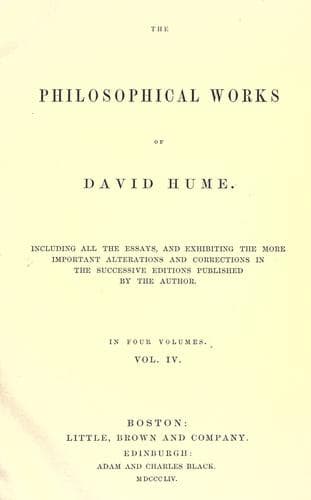
Philosophical Works, v. 1 (of 4): Including All the Essays, and Exhibiting the More Important Alterations and Corrections in the Successive Editions Published by the AuthorHume, David
PhilosophyPhilosophy
Philosophical Works, v. 1 (of 4): Including All the Essays, and Exhibiting the More Important Alterations and Corrections in the Successive Editions Published by the Author
Hume, David
Knowledge, Theory of; Philosophy, English -- 18th century
Could Mr Hume, after so many instances of disdain on my
part, have still the astonishing generosity as to persevere
sincerely to serve me? He knew it was impossible for me to
accept his good offices, so long as I entertained for him
such sentiments as I had conceived. He had himself avoided
an explanation. So that to serve me without justifying
himself, would have been to render his services useless;
this therefore was no generosity. If he supposed that in
such circumstances I should have accepted his services, he
must have supposed me to have been an infamous scoundrel.
It was then in behalf of a man whom he supposed to be a
scoundrel, that he so warmly solicited a pension from his
Majesty. Can any thing be supposed more extravagant?
But let it be supposed that Mr Hume, constantly pursuing
his plan, should only have said to himself, This is the
moment for its execution; for, by pressing Rousseau to
accept the pension, he will be reduced either to accept or
refuse it. If he accepts it, with the proofs I have in hand
against him, I shall be able completely to disgrace him:
if he refuses, after having accepted it, he will have no
pretext, but must give a reason for such refusal. This is
what I expect; if he accuses me, he is ruined.
If, I say, Mr Hume reasoned with himself in this manner,
he did what was consistent with his plan, and in that
case very natural; indeed this is the only way in which
his conduct in this affair can be explained, for upon
any other supposition it is inexplicable: if this be not
demonstrable, nothing ever was so. The critical situation
to which he had now reduced me, re-recalled strongly to my
mind the four words I mentioned above; and which I heard
him say and repeat, at a time when I did not comprehend
their full force. It was the first night after our
departure from Paris. We slept in the same chamber, when,
during the night, I heard him several times cry out with
great vehemence, in the French language, _Je tiens J. J.
Rousseau._ 'I have you, Rousseau.' I know not whether he
was awake or asleep.[39]
Public-domain text, read in full here on John Shaqi.
Reviews
Reviews
No reviews yet
Be the first to share your thoughts on this work.
Join the Discussion
Join the discussion
Sign in to leave a comment or review.
Sign InorCreate an account