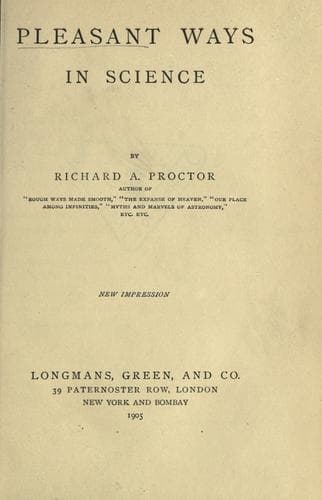
Pleasant Ways in ScienceProctor, Richard A. (Richard Anthony)
Science
Pleasant Ways in Science
Proctor, Richard A. (Richard Anthony)
Science
But who could hope to measure a velocity approaching 200,000 miles in a
second? At a first view the task seems hopeless. Wheatstone, however,
showed how it might be accomplished, measuring by his method the yet
greater velocity of freely conducted electricity. Foucault and Fizeau
measured the velocity of light; and recently Cornu has made more exact
measurements. Knowing, then, how many miles light travels in a second,
and in how many seconds it comes to us from the sun, we know the sun’s
distance.
The first of the methods which I here describe as new methods must next
be considered. It is one which Leverrier regards as the method of the
future. In fact, so highly does he esteem it, that, on its account, he
may almost be said to have refused to sanction in any way the French
expeditions for observing the transit of Venus in 1874.
The members of the sun’s family perturb each other’s motions in a
degree corresponding with their relative mass, compared with each
other and with the sun. Now, it can be shown (the proof would be
unsuitable to these pages,[10] but I have given it in my treatise
on “The Sun”) that no change in our estimate of the sun’s distance
affects our estimate of his mean density as compared with the earth’s.
His substance has a mean density equal to one-fourth of the earth’s,
whether he be 90 millions or 95 millions of miles from us, or indeed
whether he were ten millions or a million million miles from us
(supposing for a moment our measures did not indicate his real distance
more closely). We should still deduce from calculation the same
unvarying estimate of his mean density. It follows that the nearer
any estimate of his distance places him, and therefore the smaller it
makes his estimated volume, the smaller also it makes his estimated
mass, and in precisely the same degree. The same is true of the planets
also. We determine Jupiter’s mass, for example (at least, this is the
simplest way), by noting how he swerves his moons at their respective
(estimated) distances. If we diminish our estimate of their distances,
we diminish at the same time our estimate of Jupiter’s attractive
power, and in such degree, it may be shown (see note), as precisely to
correspond with our changed estimate of his size, leaving our estimate
of his mean density unaltered. And the same is true for all methods of
determining Jupiter’s mass. Suppose, then, that, adopting a certain
estimate of the scale of the solar system, we find that the resulting
estimate of the masses of the planets and of the sun, _as compared with
the earth’s mass_, from their observed attractive influences on bodies
circling around them or passing near them, accords with their estimated
perturbing action as compared with the earth’s,—then we should infer
that our estimate of the sun’s distance or of the scale of the solar
system was correct. But suppose it appeared, on the contrary, that
the earth took a larger or a smaller part in perturbing the planetary
Public-domain text, read in full here on John Shaqi.
Reviews
Reviews
No reviews yet
Be the first to share your thoughts on this work.
Join the Discussion
Join the discussion
Sign in to leave a comment or review.
Sign InorCreate an account