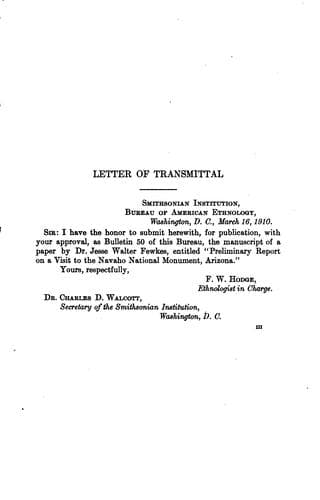
Preliminary report on a visit to the Navaho National Monument, ArizonaFewkes, Jesse Walter
History
Preliminary report on a visit to the Navaho National Monument, Arizona
Fewkes, Jesse Walter
Arizona -- Antiquities; Cliff-dwellings -- Arizona; Navajo National Monument (Ariz.)
The chief kiva at Walpi, that used by the Snake fraternity, is
rectangular and subterranean, while that used by the Flute priests,
which is practically a ceremonial room, is a chamber entered by a side
doorway. It is suggested that the Snake kiva at Walpi was derived
from the circular subterranean kiva of Tokónabi, the former home
of the Snake clan in northern Arizona, and that the Flute chamber
was developed from the rectangular rooms in the same ruins. The old
question, so often considered by Southwestern archeologists, whether
the circular subterranean kiva was derived from the rectangular or
_vice versa_, seems to the writer to be somewhat modified by the fact
that ceremonial rooms of both forms exist side by side in many ancient
cliff-dwellings. From circular subterranean kivas in some instances
developed square kivas, but the latter are sometimes the direct
development of square rooms; the determination of the original form can
best result from a study of clans and their migrations.[55]
Naturally the questions one asks in regard to these ruins are: Why
did the inhabitants build in these cliffs? Who were the ancient
inhabitants? When were these dwellings inhabited and deserted?
It is commonly believed that the caves were chosen for habitations
because they could be better defended than villages in the open. This
is a good answer to the first question, so far as it goes, although
somewhat imperfect. The ancients chose this region for their homes
on account of the constant water supply in the creek and the patches
of land in the valley that could be cultivated. This was a desirable
place for their farms. Had there been no caves in the cliffs they would
probably have built habitations in the open plain below. They may have
been harassed by marauders, but it must be borne in mind that their
enemies did not come in great numbers at any one time. Defense was
not the primary motive that led the sedentary people of this canyon
to utilize the caverns for shelter. Again, the inroads of enemies
never led to the abandonment of these great cliff-houses, if we can
impute valor in any appreciable degree to the inhabitants. Fancy, for
instance, the difficulty, or rather improbability, of a number of
nomadic warriors great enough to drive out the population of Kitsiel,
making their way up Cataract canyon and besieging the pueblo. Such an
approach would have been impossible. Marauders might have raided the
Kitsiel cornfields, but they could not have dislodged the inhabitants.
Even if they had succeeded in capturing one house but little would have
been gained, as it was a custom of the Pueblos to keep enough food in
store to last more than a year. In this connection the question is
pertinent, While hostiles were besieging Kitsiel how could they subsist
during any length of time? Only with the utmost difficulty, even with
aid of ropes and ladders, can one now gain access to some of these
ruins.
Public-domain text, read in full here on John Shaqi.
Reviews
Reviews
No reviews yet
Be the first to share your thoughts on this work.
Join the Discussion
Join the discussion
Sign in to leave a comment or review.
Sign InorCreate an account