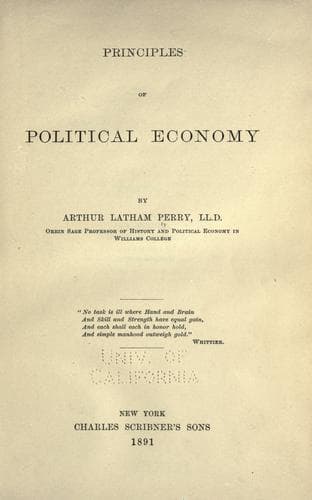
Principles of Political EconomyPerry, Arthur Latham
General
Principles of Political Economy
Perry, Arthur Latham
Economics
But all considerable variations of market-rate are commonly checked at
an earlier point than the one just indicated by variations in the
Supply. A sharper Demand carries up the market-rate, and a higher
market-rate commonly acts upon Supply to enlarge it, and an increased
Supply too checks the rise of market-rate. _Per contra_, a slacker
Demand lowers market-rates, and lowered rates often lessen the Supply
by the action of holders and speculators,--holders withdrawing their
stock for a better market, and speculators buying now when the article
is cheap to store away until it shall be dearer. Thus rise of
market-rate from Demand growing stronger is checked doubly; first, by
curtailing the number of would-be buyers, and second, by enlarging the
Supply: the fall of market-rate from Demand growing weaker is checked
doubly; first, by increasing the number of consumers of a now cheaper
article, and second, by a diminution of Supply by the action of
holders and speculators. This double and harmonious working of the law
of the Equalization of Demand and Supply is one of the most
comprehensive and beautiful laws in Political Economy.
Besides this, we must note the effect on Value of conditions in Supply
only, Demand being supposed to continue steady. There are three
classes of valuables in respect to the law of their Supply. (1) When
the Supply is scant, and cannot be increased at all, as is the case
with choice antiques and certain gems and paintings by the old
masters, their value may rise to any point under the action of Demand,
there is and can be in such cases no market-rate, and the individual
value will be struck at the point of equalization of the demand then
existing with the supply there offered. For instance, the French
Government paid, in 1852, 615,300 francs for a painting by Murillo,
which had belonged to Marshal Soult. The genuine Murillos are
comparatively few, and their number cannot be increased, and their
merit causes a strong "desire" to possess them, and their value rises
in connection with the limitation of Supply to a point beyond which no
one purchaser can be found. When this painting was offered in Paris
for sale, many "persons" of course were anxious to buy it, there was
but one painting, there could be but one purchaser, value rose under
the influence of a sharp Demand, the rise could not be checked by any
duplication of the Supply, and the equation was complete and the value
for that sale determined when one party distanced all other
competitors and offered a sum greater than any one else would give.
The same principle controls all sales of this sort, and is practically
the principle of the _Auction_, whose very name indicates its nature
in this regard, that Demand becomes restricted to one party, and that
the highest bidder.
Public-domain text, read in full here on John Shaqi.
Reviews
Reviews
No reviews yet
Be the first to share your thoughts on this work.
Join the Discussion
Join the discussion
Sign in to leave a comment or review.
Sign InorCreate an account