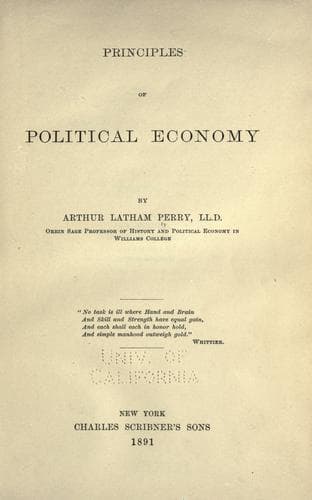
Principles of Political EconomyPerry, Arthur Latham
General
Principles of Political Economy
Perry, Arthur Latham
Economics
(c) It only remains in this branch of the general discussion on Value,
to indicate the Limits, within which all oscillations of Value are
contained. These extreme limits are specially to be found in the
element of Value which we have called "Efforts." We have clearly seen
already, that "efforts" (or Labor) are not, as has been often
asserted, the cause of Value, but only one of several constituent
causes; if Labor be asserted to be the sole cause of Value, the
inquiry becomes instantly pertinent, what is the cause of the value of
Labor; yet we know, that "efforts" always stand in preconnection with
value, and, the mutual "desires" being presupposed, there must always
be Limitations of Value lying partly in the efforts made by the person
serving and partly in the efforts saved to the person served. In every
valuable transaction, each of the parties is reciprocally serving and
served, and it is clear, that the two would not exchange "renderings"
unless the service which each renders to the other is less onerous
than the "efforts" which each would have to make if each served
himself directly. For example, it takes a certain effort for me to
bring water from the spring for the use of my family; I am willing to
pay a neighbor for bringing it for me, but I should not be willing to
make a greater effort for him in return than the effort is to bring it
myself; neither should I be willing to make an effort for him in
return which I regarded just as onerous as the bringing the water
myself; and unless there is some service which he will accept less
onerous to me than that, I shall continue to bring the water. On the
other hand, he will surely not render the service to me of bringing
the water, unless it be less onerous to him to do so than the doing
that for himself which I am ready to do for him.
This principle, applicable to all exchanges whatsoever, draws on the
one side the outermost line, beyond which Value never can pass. It may
be asserted with confidence, that no person will ever knowingly make a
greater effort to satisfy a desire through exchange, than the effort
needful to satisfy it without an exchange. Therefore, it follows,
that all exchanges lessen onerous efforts among men relatively to the
satisfaction of their desires, and tend to lessen these more and more
as exchanges multiply in number and variety, otherwise the exchanges
would not take place.
Public-domain text, read in full here on John Shaqi.
Reviews
Reviews
No reviews yet
Be the first to share your thoughts on this work.
Join the Discussion
Join the discussion
Sign in to leave a comment or review.
Sign InorCreate an account