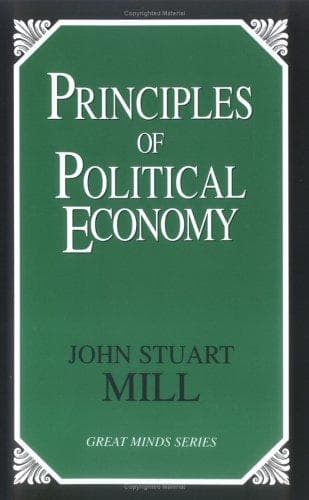
Principles of Political Economy: Abridged with Critical, Bibliographical, and Explanatory Notes, and a Sketch of the History of Political EconomyMill, John Stuart
PhilosophyPhilosophy
Principles of Political Economy: Abridged with Critical, Bibliographical, and Explanatory Notes, and a Sketch of the History of Political Economy
Mill, John Stuart
Economics
Professor Fawcett, “Manual” (chap. ii), says: “Since the laborer
must be fed by previously accumulated food, ... some of the
results of past labor are required to be set aside to sustain the
laborer while producing. The third requisite of production,
therefore, is a fund reserved from consumption, and devoted to
sustain those engaged in future production.... Capital is not
confined to the food which feeds the laborers, but includes
machinery, buildings, and, in fact, every product due to man’s
labor which can be applied to assist his industry” (chap. iv).
General Walker (“Political Economy,” pages 68-70) defines capital
as that portion of wealth (excluding unimproved land and natural
agents) which is employed in the production of new forms of
wealth. Henry George (“Progress and Poverty,” page 41) returns to
Adam Smith’s definition: “That part of a man’s stock which he
expects to yield him a revenue is called his capital.” Cherbuliez
(“Précis,” page 70) points out the increasing interdependence of
industrial operations as society increases in wealth, and that
there is not a single industry which does not demand the use of
products obtained by previous labor. “These auxiliary products
accumulated with a view to the production to which they are
subservient” form what is called capital. Carey (“Social Science,”
iii, page 48) regards as capital all things which in any way form
the machinery by which society obtains wealth. Roscher’s
definition is, “Every product laid by for purposes of further
production.” (“Political Economy,” section 42.) By some, labor is
regarded as capital.(104)
A manufacturer, for example, has one part of his capital in the form of
buildings, fitted and destined for carrying on this branch of manufacture.
Another part he has in the form of machinery. A third consists, if he be a
spinner, of raw cotton, flax, or wool; if a weaver, of flaxen, woolen,
silk, or cotton thread; and the like, according to the nature of the
manufacture. Food and clothing for his operatives it is not the custom of
the present age that he should directly provide; and few capitalists,
except the producers of food or clothing, have any portion worth
mentioning of their capital in that shape. Instead of this, each
capitalist has money, which he pays to his work-people, and so enables
them to supply themselves. What, then, is his capital? Precisely that part
of his possessions, whatever it be, which he designs to employ in carrying
on fresh production. It is of no consequence that a part, or even the
whole of it, is in a form in which it can not directly supply the wants of
laborers.
Public-domain text, read in full here on John Shaqi.
Reviews
Reviews
No reviews yet
Be the first to share your thoughts on this work.
Join the Discussion
Join the discussion
Sign in to leave a comment or review.
Sign InorCreate an account