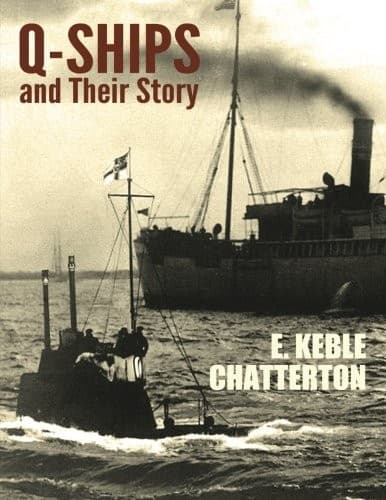
Q-Ships and Their StoryChatterton, E. Keble (Edward Keble)
History
Q-Ships and Their Story
Chatterton, E. Keble (Edward Keble)
Q-ships; World War, 1914-1918 -- Naval operations
After the return to Lowestoft, _Result_ was altered in appearance and
was sent off to the area where this encounter had taken place. This
time she used Swedish colours, and called herself the _Dag_. On this
voyage, whilst in the vicinity north of the North Hinder Bank, on April
4, about 4 a.m., a submarine was seen on the port bow, but disappeared.
It was so big that at first it resembled a steamer or destroyer.
Presently a periscope was seen about 4 points on the bow, resembling
a topmast, as it had a rake. The lower portion was about 6 inches in
diameter, and a narrower stem protruded from this, terminating in a
ball, and whilst officers and crew watched it, wondering whether it was
the mast of a wreck or not, it slowly dipped and vanished. This was
the submarine in the act of taking a photograph. She then retired to a
distance convenient for shelling. There was a light westerly breeze,
and the enemy now bobbed up at intervals all round the _Dag_, examining
her very carefully. Lieutenant Muhlhauser writes of this incident:
‘Then followed a pause of nearly half an hour without our seeing
anything of him. The cook was sent to the galley to get on with
breakfast and we started the engine. It is hardly necessary to say that
as it was particularly wanted it ran very badly, and, indeed, could
hardly be kept going at all. Suddenly a shell burst near us, followed
by another and another. We could not at first tell the direction from
which they came, and thought it was from astern, but found that the
submarine had cunningly moved away towards the sun, and had emerged in
the mist behind the path of the sun, where he was practically invisible
from our ship, while we were lit up and must have offered a splendid
target with our white hull and sails. His shooting was very good,
and none of the shells missed us by much. He fired rapidly, and was
probably using a 4·1-inch semi-automatic gun. The shells all burst on
striking the water, and the explosions had a vicious sound. They seemed
to come at a terrific speed, suggesting a high-velocity gun. The C.O.
calmly walked the deck, the skipper took the wheel, and I sat at the
top of the cabin hatchway and noted the times and numbers of shells
fired and anything else of interest. The rest of the crew were at their
stations, but keeping below the bulwarks, except those who launched the
boat and let it tow astern. The eleventh shell struck us just above
the water-line, and soused us all with spray which flew up above the
peak of the mainsail. It tore a hole in the side and burst in the sand
ballast, reducing the skipper’s cabin to matchwood, and destroying the
wireless instrument. It also knocked down the sides of the magazine and
set fire to the wood, starting some of the rockets smouldering. It also
smashed up the patent fire extinguishers, and possibly the fumes from
these prevented the fire from spreading. Anyway, it was out when we
had time to see what was happening.
Public-domain text, read in full here on John Shaqi.
Reviews
Reviews
No reviews yet
Be the first to share your thoughts on this work.
Join the Discussion
Join the discussion
Sign in to leave a comment or review.
Sign InorCreate an account