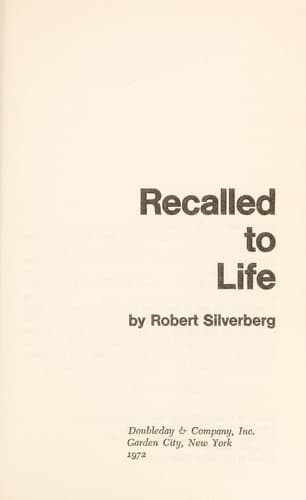
Death -- Fiction; Immortalism -- Fiction; Science fiction
"The United States has always been the world pioneer," declared Senator
Marshall of Alabama, the elder statesman of the American Conservatives.
"We never show fear as we approach the boundary between the known and
the unknown. But we must exert caution in this new step, and take care
lest we move recklessly forward and unleash forces which can destroy
the bonds of society."
The medical societies had statements, too--sound ones. "The problem,"
declared an A.M.A. spokesman, "is essentially a soul-searing one. If
the Beller process is valid, every physician will have the power to
return life to the dead. Shall he make use of this power whenever he
can? Or will there be the danger of giving life indiscriminately,
to those perhaps who do not merit a reprieve? What will happen if a
dead man's family refuses the right of reanimation? Can the physician
proceed? And is he guilty of murder if he does not? Who will make the
decisions? An entirely new code of medical ethics must be developed
before any wide-scale practice of reanimation can be permitted."
These were sound viewpoints, and Harker had no issue with them. But
there were other, more hysterical voices clamoring in the newspapers,
and hundreds of vituperous letters had already descended on the
Litchfield post office as well.
People who feared death feared reanimation more. There were those who
assumed that reanimation might become the property of an aristocracy
that would perpetuate itself over and over, while leaving the common
people to death. There were those who dreaded the return to life of
a loved one, who were unwilling to face again someone who had been
"beyond" and returned.
Fear and ignorance, ignorance and fear. Harker read the letters in the
newspapers, and his head swam. The ones received direct were even worse.
... _you are violating the command of God brought on us by Adam's
fall, Harker. But you will rot in Hell for it._
... _you Harker and Raymond and the others there should have been
strangled in your cribs. Bringing the dead back from the grave is
disgusting. You will fill the world with a race of undead zombies._
... _I know what it is to have a loved one die, do you?_ (Yes,
Harker thought.) _But I would not want to touch the lips of one who
was dead._
Harker paused a moment in thought as he read that last letter,
wondering how he would feel had Eva been brought back to him there on
the beach. He had assumed that he would welcome the idea, but now he
remembered Lois' doubtful answer to the question, and it seemed to him
that he himself was doubtful too now. Would he be able to embrace a
daughter who had died and had been reanimated? Could he--
He shook his head in bitter self-contempt. _I'm overtired_, he thought.
_All this superstitious muck is contagious. The life-process stops, it
starts again--and is anything lost? Wake up, Harker. Of course you'd
have hugged Eva if she had been brought back to life._
Public-domain text, read in full here on John Shaqi.
Reviews
Reviews
No reviews yet
Be the first to share your thoughts on this work.
Join the Discussion
Join the discussion
Sign in to leave a comment or review.
Sign InorCreate an account