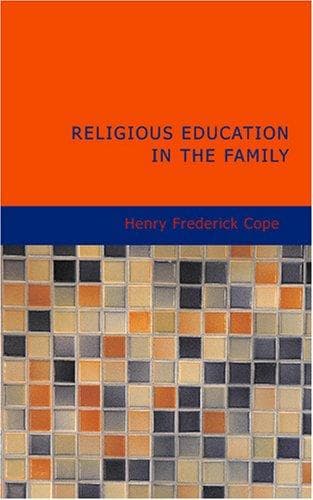
Religious Education in the FamilyCope, Henry Frederick
Religion
Religious Education in the Family
Cope, Henry Frederick
Families -- Religious life; Religious education
Each family must clearly see its normal relations to its community, to
the social whole; first, as an association of social beings having
social duties, obligations, and privileges; then, to see that the
ordering of the daily life is the largest single factor in determining
the value of the family to the development of the community, fitting
harmoniously into the larger community, and rendering its share of
service.
The disorderly home spreads its immoral contagion beyond its walls, out
into the front yard, out and up and down the street, and all through the
village and city. The City Beautiful cannot come until we have the Home
Beautiful. Training each one to play his part in keeping the house in
order, picking up and setting in place his own tools and playthings,
preventing and removing litter, scraps, and elements of disorder and
discomfort, acquiring habits of neatness based on social motives--these
things make more for the city of beauty and health than all our lectures
on clean cities.
No family lives to itself. Young people need to see clearly how their
homes and their habits in the home impinge on other homes and lives.
This is impressed upon us in an accentuated and acute degree in city
living. One can hardly imagine a finer discipline of grace than
apartment living, though one may well question whether it is not morally
and hygienically flying in the face of the natural order. We may not
have for a long time municipal ordinances forbidding boiled dinners,
limburger, and phonographs in city apartments; but if, unfortunately, we
are compelled to live in these modern abominations, we ought to
cultivate a conscience that will not inflict our idiosyncrasies, either
in culinary aromas or in musical taste, on our neighbors. But there are
matters greater than these by which the home trains for social
thoughtfulness. No man has a right to grow weeds at home, because the
seeds never stay there. A howling dog, a disease-breeding sty, a
fly-harboring stable, must be viewed, not from the point of the family's
convenience, but from that of others' welfare.
§ 6. TRAINING FOR CITIZENSHIP
The family has a duty to train children for Christian citizenship. No
other institution can take its place even here. Courses of lectures in
churches and settlements effect excellent results, and the study of
civics from the moral and ideal viewpoint should be encouraged in the
schools; but the home is the place where, after all, citizens are
trained and the value or menace of their citizenship determined. If we
stop long enough to get a clear understanding of what we mean by
citizenship this will be the more evident.
Public-domain text, read in full here on John Shaqi.
Reviews
Reviews
No reviews yet
Be the first to share your thoughts on this work.
Join the Discussion
Join the discussion
Sign in to leave a comment or review.
Sign InorCreate an account