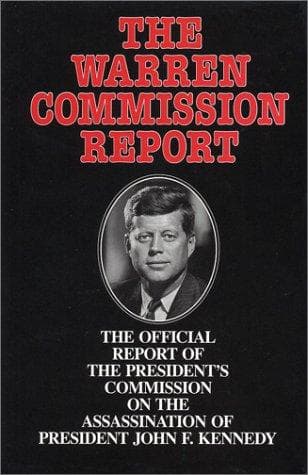
Report of the President's Commission on the Assassination of President John F. KennedyUnited States. Warren Commission
History
Report of the President's Commission on the Assassination of President John F. Kennedy
United States. Warren Commission
Kennedy, John F. (John Fitzgerald), 1917-1963 -- Assassination; Oswald, Lee Harvey
The Commission could not make any definitive determination of Oswald’s
motives. It has endeavored to isolate factors which contributed to his
character and which might have influenced his decision to assassinate
President Kennedy. These factors were:
(_a_) His deep-rooted resentment of all authority which was
expressed in a hostility toward every society in which he lived;
(_b_) His inability to enter into meaningful relationships with
people, and a continuous pattern of rejecting his environment
in favor of new surroundings;
(_c_) His urge to try to find a place in history and despair at
times over failures in his various undertakings;
(_d_) His capacity for violence as evidenced by his attempt to
kill General Walker;
(_e_) His avowed commitment to Marxism and communism, as he
understood the terms and developed his own interpretation of
them; this was expressed by his antagonism toward the United
States, by his defection to the Soviet Union, by his failure
to be reconciled with life in the United States even after
his disenchantment with the Soviet Union, and by his efforts,
though frustrated, to go to Cuba.
Each of these contributed to his capacity to risk all in cruel and
irresponsible actions.
12. The Commission recognizes that the varied responsibilities of the
President require that he make frequent trips to all parts of the
United States and abroad. Consistent with their high responsibilities
Presidents can never be protected from every potential threat. The
Secret Service’s difficulty in meeting its protective responsibility
varies with the activities and the nature of the occupant of the
Office of President and his willingness to conform to plans for his
safety. In appraising the performance of the Secret Service it should
be understood that it has to do its work within such limitations.
Nevertheless, the Commission believes that recommendations for
improvements in Presidential protection are compelled by the facts
disclosed in this investigation.
(_a_) The complexities of the Presidency have increased so
rapidly in recent years that the Secret Service has not been
able to develop or to secure adequate resources of personnel
and facilities to fulfill its important assignment. This
situation should be promptly remedied.
(_b_) The Commission has concluded that the criteria and
procedures of the Secret Service designed to identify and
protect against persons considered threats to the president,
were not adequate prior to the assassination.
(1) The Protective Research Section of the Secret Service,
which is responsible for its preventive work, lacked sufficient
trained personnel and the mechanical and technical assistance
needed to fulfill its responsibility.
Public-domain text, read in full here on John Shaqi.
Reviews
Reviews
No reviews yet
Be the first to share your thoughts on this work.
Join the Discussion
Join the discussion
Sign in to leave a comment or review.
Sign InorCreate an account