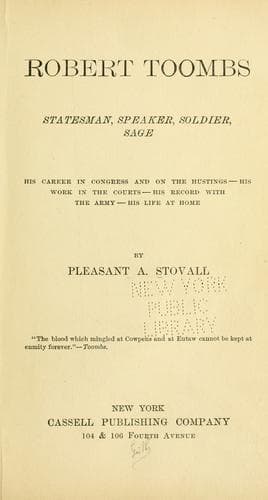
Robert Toombs: Statesman, Speaker, Soldier, SageStovall, Pleasant A.
History
Robert Toombs: Statesman, Speaker, Soldier, Sage
Stovall, Pleasant A.
Toombs, Robert Augustus, 1810-1885
On July 3, 1852, Mr. Toombs, then a member of the House, submitted an
elaborate statement of his political position. He made the point that
presidents, as then put forward, were not real representatives of the
country or even of a party. From the beginning of the government up to
1836 the presidency had been filled by ripe statesmen and tried
patriots. _All_ were excluded from competition except those who had
great experience in public affairs, and who had commended themselves to
the people by wisdom, virtue, and high services. Such men had no need of
hired biographers and venal letter-writers to inform the people who they
were. They needed no interpreters of letters to the public, cunningly
devised to mystify what they pretended to elucidate. National
conventions, Mr. Toombs contended, were contrivances to secure popular
support to those who were not entitled to public confidence.
Mr. Toombs was an enemy to mere convention. All party machinery, all
irregular organizations, which are unknown to the Constitution, he
regarded as dangerous to public liberty. He had noticed that this
machinery had been deadly to the great men of the nation and productive
only of mediocrity. Obedience to them, he contended, was infidelity to
popular rights. "This system," said he, "has produced none of those
illustrious men who have become so distinguished in their country's
history; none of those political lights which have shone so brilliantly
on this Western continent for half a century. Nearly all of them have
departed from us. Who is to take the place of the distinguished
Carolinian?" he asked. "He was the handiwork of God himself and of the
people--not party machinery. Who is to fill the place of the great
Kentuckian? When worthily filled, it will not be by these nurseries of
faction.
"The friends of the Compromise," said Mr. Toombs, "demand no sectional
candidate. They were willing to accept the great New England statesman,
notwithstanding they may point to disagreements with him in the past. He
has thrown the weight of his mighty intellect into the scales of
concord, in the darkest and most perilous hour of the conflict. And
Southern Whigs would have struggled with pride and energy to have seen
the greatest intellect of the age preside over the greatest republic of
the world. He was defeated in convention by the enemies of the
compromise measure, because he was its friend. And this was the true
reason of his exclusion. It is a sufficient reason for the friends of
the measure, North and South, to oppose and defeat General Scott's
nomination. My action shall respond to my convictions."
Public-domain text, read in full here on John Shaqi.
Reviews
Reviews
No reviews yet
Be the first to share your thoughts on this work.
Join the Discussion
Join the discussion
Sign in to leave a comment or review.
Sign InorCreate an account