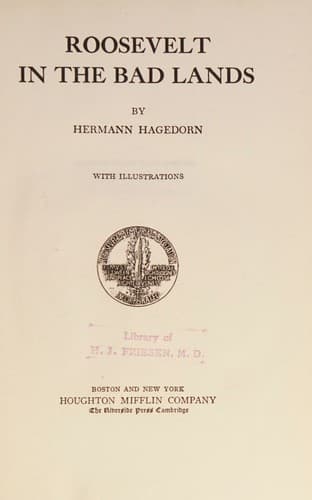
Biography; Frontier and pioneer life -- Dakota Territory; Roosevelt, Theodore, 1858-1919
Late in November a man of a different sort blew into town. His name
was A. T. Packard. He was joyously young, like almost every one else
in Little Missouri, except Maunders and Paddock and Captain Vine,
having graduated from the University of Michigan only a year before.
He drifted westward, and, having a taste for things literary, became
managing editor of the Bismarck _Tribune_. Bismarck was lurid in those
days, and editing a newspaper there meant not only writing practically
everything in it, including the advertisements, but also persuading
the leading citizens by main force that the editor had a right to say
what he pleased. Packard had been an athlete in college, and his eyes
gave out before his rule had been seriously disputed. After throwing
sundry protesting malefactors downstairs, he resigned and undertook
work a trifle less exacting across the Missouri River, on the Mandan
_Pioneer_.
Packard became fascinated with the tales he heard of Little Missouri
and Medora and, being foot loose, drifted thither late in November. It
happened that Frank Vine, who had by that time been deposed as agent
of the Gorringe syndicate, was running the Pyramid Park Hotel. He had
met Packard in Mandan and greeted him like a long-lost brother. As the
newcomer was sitting in a corner of the bar-room after supper, writing
home, Frank came up and bent over him.
"You told me down in Mandan that you'd never seen an
honest-to-goodness cowboy," he whispered. "See that fellow at the
farther end of the bar? Well, that's a real cowboy."
Packard looked up. The man was standing with his back toward the wall,
and it struck the tenderfoot that there was something in his attitude
and in the look in his eye that suggested that he was on the watch and
kept his back to the wall with a purpose. He wore the paraphernalia of
the cowboy with ease and grace.
Packard started to describe him to his "folks" in distant Indiana. He
described his hat, his face, his clothes, his shaps, his loosely
hanging belt with the protruding gun. He looked up and studied the
man; he looked down and wrote. The man finally became conscious that
he was the subject of study. Packard observed Frank Vine whisper a
word of explanation.
He finished his letter and decided to take it to the "depot" and ask
the telegraph operator to mail it on the east-bound train that passed
through Little Missouri at three. He opened the door. The night was
black, and a blast of icy wind greeted him. He changed his mind.
The next afternoon he was riding up the river to the Maltese Cross
when he heard hoofs behind him. A minute later the object of his
artistic efforts of the night before joined him and for an hour loped
along at his side. He was not slow in discovering that the man was
pumping him. It occurred to him that turn-about was fair play, and he
told him all the man wanted to know.
Public-domain text, read in full here on John Shaqi.
Reviews
Reviews
No reviews yet
Be the first to share your thoughts on this work.
Join the Discussion
Join the discussion
Sign in to leave a comment or review.
Sign InorCreate an account