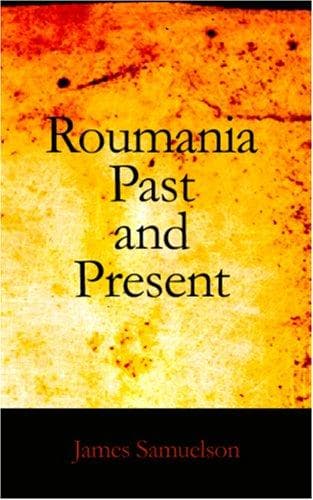
Romania -- Description and travel; Romania -- History
[Footnote 47: As reference has been made from time to time to Roumanian
ecclesiastics, the following brief particulars may not be uninteresting.
Christianity was introduced into the provinces bordering on the Danube
at a very early date. According to A. de Gerando (_Siebenbürgen und
seine Einwohner_, p. 211, Lorck, Leipzig, 1845), a MS. was found in
Hungary, bearing a cross and the date 274 A.D.; and in 325
A.D. a Bishop Theophilus was spoken of amongst the Goths. In
370 A.D. Athanaric, the Gothic king, persecuted and put many
Christians to death. In 527 A.D. the Christian churches of
Roumania (as then constituted) were taken in charge by the metropolitan
of the Greek Church. But it was not until 865 A.D. that the
Bulgarians and the native population associated with them were actually
converted to Christianity (Lauriani, p. 29). About that time intrigues
existed between the heads of the Eastern and Western Churches for the
possession of the headship in these countries, but the influence of the
former predominated. About 860 A.D. a Slavonian liturgy was
introduced into the churches, and, notwithstanding the denunciations and
embassies of the Roman Pontiff, a separation occurred about 880 A.D.,
and the Roumanians joined the Orthodox Greek Church. Of the negotiations
between Innocent III. and Johannitz, King of the Second
Wallacho-Bulgarian monarchy, we shall speak hereafter, and although
after that time the Papal power was in the ascendant in Wallachia and
Moldavia amongst the princes and nobles, the people always leaned to the
Greek rite, and at length, in 1440, the metropolitan of Moldavia
succeeded (Romish writers say by a religious _coup d'état_) in making
the Greek Church dominant. In the middle of the seventeenth century the
most important Roman Catholic bishopries were suppressed, and down to
the present time the Greek Church has been the state religion, and it is
professed by nearly the whole nation; even the King, who was formerly a
Roman Catholic, now conforms to the faith. Of the secularisation of the
monasteries and other religious movements we shall speak in Part II, and
it is only necessary to add that at present there are two metropolitans
or archbishops, six bishops with dioceses and several without; in 1876
there were 9,800 secular priests, 1,700 monks and 2,270 nuns, 6,550
churches and 173 monasteries and nunneries. The priests or 'popes' marry
and follow secular occupations in the country; in the towns they are
'non-productive' so far as labour is concerned. The services of the
Greek Church are not impressive; but although much has been written
concerning their superstition, the Roumanians do not differ greatly from
the people of other Catholic countries in that respect. There is great
indifference to religion, if not absolute atheism, amongst the higher
classes, which no doubt results from the great ignorance of the
priesthood. The thing most to be regretted, however, is that whilst
Public-domain text, read in full here on John Shaqi.
Reviews
Reviews
No reviews yet
Be the first to share your thoughts on this work.
Join the Discussion
Join the discussion
Sign in to leave a comment or review.
Sign InorCreate an account