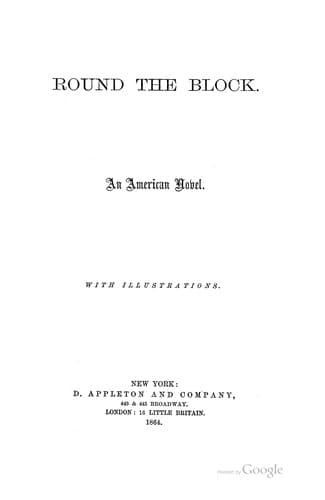
Round the Block: An American NovelBouton, John Bell
General
Round the Block: An American Novel
Bouton, John Bell
City and town life -- Fiction; Male friendship -- Fiction; New York (N.Y.) -- Social life and customs -- Fiction
Just as Mr. Pillbody was making arrangements to bring these mines before
the public, his stockbroking friend, through whom he had effected the
purchase, left for Europe, and it was then discovered that Mr.
Pillbody's mines, if they existed at all, were ten feet under a swamp,
on property which belonged to somebody else, the title deeds of which
had been forged by the adroit operator. Mr. Pillbody could not endure
his misfortune. He wrote notes bidding farewell to his wife and child,
and commending them to the care of their relatives, to whom he had
always been bountifully generous. Then he went to Staten Island by
ferry, there took a row boat, proceeded to a celebrated oyster bed which
was the scene of his youthful labors, and drowned himself.
The widow and daughter (the latter twenty years of age, healthy, and
finely educated) applied to the two brothers of the deceased for
assistance, and were at once kindly received into their families, and
sat upon sofas and ate from tables purchased with money (never repaid)
of the late Mr. Pillbody. The two brothers, upon application to the
proper tribunal, were appointed executors of the estate, and were not
long in discovering that it was insolvent. Mother and daughter were
shifted about with almost monthly regularity from one house to the
other; and, though they tried to make themselves useful in every
capacity except that of a servant, they could not disguise the
conviction that their departure was an event a great deal more welcome
than their coming. The widow's talent for dressmaking (she had been a
milliner's apprentice before marriage), though of a high order, and
exerted to the utmost, failed to please. Miss Pillbody's thorough
knowledge of French, and the higher branches of an elegant education, as
well as her proficiency on the piano, and her sweet, simple style of
ballad singing, were worse than useless acquirements in her
uncles' families.
Her uncles were cold, stern, ignorant men, who had an intense hatred for
the mere accomplishments of life. Each had two daughters, who, with the
natural tastes of the sex, were not averse to the graces of education,
in the abstract, but could not bear to see them displayed by their
"stuck-up, pauper cousin," as they often termed that hapless young lady
in private conversation. A kind offer, which she was imprudent enough,
to make, to teach them all she knew, had set them against her from
the first.
Public-domain text, read in full here on John Shaqi.
Reviews
Reviews
No reviews yet
Be the first to share your thoughts on this work.
Join the Discussion
Join the discussion
Sign in to leave a comment or review.
Sign InorCreate an account