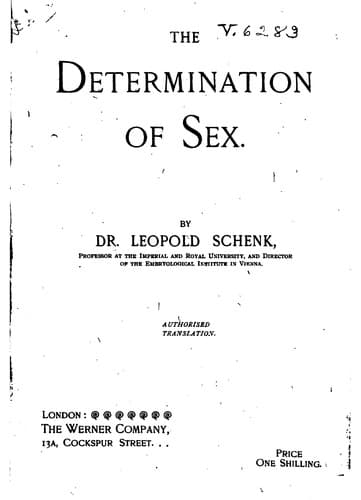
Schenk's Theory: The Determination of Sex — John Shaqi
Schenk's Theory: The Determination of SexSchenk, Samuel Leopold
Science
Schenk's Theory: The Determination of Sex
Schenk, Samuel Leopold
Sex determination, Genetic; Sex preselection
In fact, we have frequently touched upon such subjects, although only
lightly. Here, as we are about to proceed to the subjects of nutrition
and metabolism in the human female awaiting impregnation, we find
ourselves compelled to acquaint the reader with a number of facts which
permit us to assume a connection between the food supply (including
metabolism) and the development of sex.
CHAPTER II
According to St. Hilaire, the male sex is more common in the case
of scantily nourished (and therefore weakly) animals. Giron de
Buzareingues says that the same is sometimes the case with domesticated
mammalia. Martegoute has found that the sheep which bear female
offspring are, on the average, of a heavier weight. Furriers have
remarked that in fruitful regions more furs of female animals are
always to be had than in unfruitful districts. It would follow from
this that better nourishment assists the production of females.
This observation seems, however, to be concordant with the general
practice of farmers, according to which it is usual to keep a greater
number of the females of the domesticated animals, on account of
their utility. The males are kept only in such numbers as may be
absolutely necessary for breeding purposes, or for stronger beasts
of burden. The surplus is, by means of trade, disposed of in other
regions. In consequence, in poor unfruitful districts, the number of
males is pretty nearly the same as in fruitful regions, the actual
requisite number being in both cases about the same. The females, on
the contrary, can be much better kept in fruitful districts, where
there are rich and fertile meadows and better fodder, than in the poor
regions. In the latter the females are consequently rarer.
Wilkens attempted to apply diet to the production of sex in the
domesticated mammalia, and laid down the following principles: The food
must be of influence upon the embryo in the mother’s womb, and the
better nourishment favors the female, the worse the male sex.
We have already mentioned the views of Robin and Born respecting the
influence of food.
Düsing turned his attention to the effect of diet upon horses, with a
view to the development of sex.
The state of nutrition of the parents would have an influence upon the
development of the embryo. In this case, also, the better condition
produced females, the worse males.
According to Düsing, if the mother was well nourished, old semen
operating upon a young ovum would produce a majority of female
offspring. On the other hand, if the mother was insufficiently fed,
young semen operating upon an old ovum would produce a majority of male
individuals.
According to Wappaens, richer or poorer nourishment in years of
different fruitfulness in Sweden has no effect upon the prevalence of
one or the other sex.
Public-domain text, read in full here on John Shaqi.
Reviews
Reviews
No reviews yet
Be the first to share your thoughts on this work.
Join the Discussion
Join the discussion
Sign in to leave a comment or review.
Sign InorCreate an account