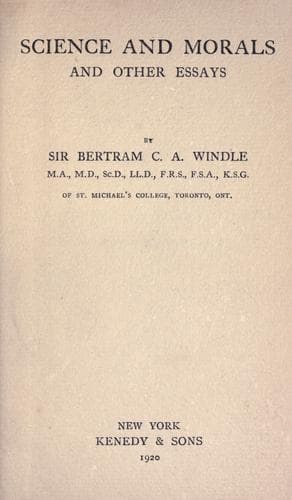
Science and Morals and Other EssaysWindle, Bertram Coghill Alan, Sir
Religion
Science and Morals and Other Essays
Windle, Bertram Coghill Alan, Sir
Essays; Religion and science; Science
perusal of their works would have warned off later comers.
Oh, irony of fate! the same thing precisely happens when men of
scientific eminence indulge in religious dissertations, for of course,
though it is not quite so obvious to such writers, the same blunder is
quite possible in non-scientific fields of knowledge. I once asked one
versed in theology what he thought of the religious articles of a
distinguished man, unfamiliar himself with theology, yet, none the less,
then splashing freely and to the great admiration of the ignorant, in
the theological pool. His reply was that in so far as they were at all
constructive, they consisted mostly of exploded heresies of the first
century. Is not this precisely what one would have expected _a priori_?
A man commencing to write on science or religion who neglects the work
of earlier writers places himself in the position of the first students
of the subject and very naturally will make the same mistakes as they
made. He refuses to be hampered and biased by knowledge, and the result
follows quite inevitably. "A scientist," says Monsignor Benson, "is
hampered and biased by knowing the earth goes round the sun." The fact
of the matter is that the man of science is not a solitary figure, a
_chimaera bombinans in vacuo_. In whatever direction he looks he is faced
by the figures of other workers and he is limited and "hampered" by
their work. Nor are these workers all of them in his own area of
country, for the biologist, for example, cannot afford to neglect the
doings of the chemist; if he does he is bound to find himself led into
mistakes. No doubt the scientific man is at times needlessly hampered by
theories which he and others at the time take to be fairly well
established facts, but which after all turn out to be nothing of the
kind. This in no way weakens the argument, but rather by giving an
additional reason for caution, strengthens it.
If we carefully consider the matter we shall be unable to come to any
other conclusion than that every writer, even of the wildest form of
fiction, is in some way and to some extent hampered and limited by
knowledge, by facts, by things as they are or as they appear to be. That
will be admitted; but it will be urged that the hampering and limiting
with which we have been dealing is not merely legitimate but inevitable,
whereas the hampering and limiting--should such there be--on the part of
the Church is wholly illegitimate and indefensible.
Public-domain text, read in full here on John Shaqi.
Reviews
Reviews
No reviews yet
Be the first to share your thoughts on this work.
Join the Discussion
Join the discussion
Sign in to leave a comment or review.
Sign InorCreate an account