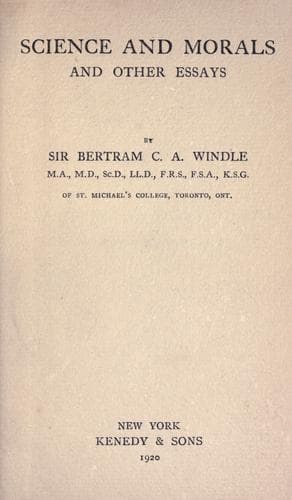
Science and Morals and Other EssaysWindle, Bertram Coghill Alan, Sir
Religion
Science and Morals and Other Essays
Windle, Bertram Coghill Alan, Sir
Essays; Religion and science; Science
It ought to be widely known, though it is not, that the idea that
theologians can or wish to intrude--again _qua_ theologians--in
scientific disputes as to chemical, biological, or other facts, is a
fantastic idea without real foundation save that of the one mistake of
the kind made in the case of Galileo and never repeated--a mistake, let
us hasten to add, made by a disciplinary authority and--as all parties
admit--in no way involving questions of infallibility. To this case we
will revert shortly. Meanwhile it may be briefly stated that the claim
made by the Church is in connection with some few--some very few--of
the _theories_ which men of science build up upon the facts which they
have brought to light. Some of these theories do appear to contradict
theological dogmas, or at least may seem to simple people to be
incompatible with such dogmas, just as the people of his
time--Protestants by the way, no less than Catholics--did really think
that Galileo's theory conflicted with Holy Writ. In such cases, and in
such cases alone, the Church holds that she has at least the right to
say that such a theory should not be proclaimed to be true until there
is sufficient proof for it to satisfy the scientific world that the
point has been demonstrated.
This is really what is meant by the tyranny of the Church; and it may
now be useful to consider briefly what can be said for her position. We
must begin by looking at the matter from the Church's standpoint. It is
a good rule to endeavour to understand your opponent's position before
you try to confute him; an excellent rule seldom complied with by
anti-Catholic controversialists. Now the Church starts with the
proposition that man has an immortal soul destined to eternal happiness
or eternal misery, and she proceeds to claim that she has been divinely
constituted to help man to enjoy a future of happiness. Of course these
are opinions which all do not share, and with the arguments for and
against which we cannot here deal. If a man is quite sure that he has no
soul and that there is no hereafter there is nothing more to be said
than: "Let us eat and drink, for to-morrow we die." Nothing very much
matters in this world except that we should make ourselves as
comfortable as we can during the few years we have to spend in it.
Again, there are others who, whilst believing the first doctrine set
down above, will have none of the other. With them we enter into no
argument here, and only say that to have a guide is better than to have
no guide. Catholics, who accept gratefully her guidance, do believe that
the Church can help a man to save his soul, and that she is entrusted,
to that end, with certain powers. Her duty is to preserve and guard the
Christian Revelation--the scheme of doctrine regarding belief and
conduct by which Jesus Christ taught that souls were to be saved. She is
not an arbitrary ruler. Her office is primarily that of Judge and
Interpreter of the deposit of doctrine entrusted to her.
Public-domain text, read in full here on John Shaqi.
Reviews
Reviews
No reviews yet
Be the first to share your thoughts on this work.
Join the Discussion
Join the discussion
Sign in to leave a comment or review.
Sign InorCreate an account