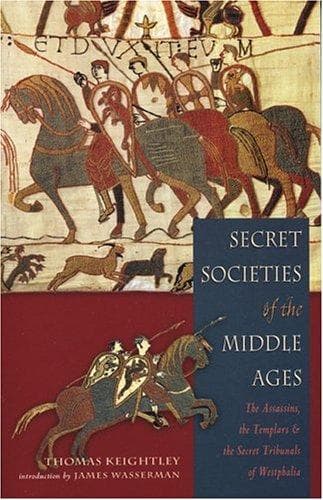
Secret Societies of the Middle AgesKeightley, Thomas
History
Secret Societies of the Middle Ages
Keightley, Thomas
Secret societies
This year was, however, near proving fatal to the society in Syria.
Risvan, their great protector, died; and the eunuch Looloo, the guardian
of his young son, was their sworn enemy. An order for their
indiscriminate destruction was forthwith issued, and, in consequence,
more than 300 men, women, and children were massacred, while 200 more
were thrown into prison. Aboo-'l-Fettah was put to death with torture;
his body was cut to pieces and burnt at the gate looking towards Irak,
and his head sent through all Syria. They did not, however, fall totally
unavenged; the daggers of the society were directed against the
governors and men in power, many of whom became their victims. Thus, in
the year 1115, as the Attabeg Togteghin was receiving an audience at the
court of the khalif of Bagdad, the governor of Khorasan was fallen upon
by three Ismaïlites, who probably mistook him for the Attabeg, and he
and they perished. In 1119 as Bediï, the governor of Aleppo, was
journeying with his sons to the court of the emir Il-Ghazi, they were
fallen upon by two assassins; Bediï and one of his sons fell by their
blows; his other sons cut the murderers down; but a third then sprang
forth, and gave the finishing stroke to one of the young men, who was
already wounded. The murderer was taken, and brought before Togteghin
and Il-Ghazi, who only ordered him to be put in prison; but he drowned
himself to escape their vengeance, from which he had, perhaps, nothing
to apprehend.
In fact at this time the dread of the followers of Hassan Sabah had sunk
deep into the hearts of all the princes of the East, for there was no
security against their daggers. Accordingly, when the next year (1120)
Aboo Mohammed, the head of them at Aleppo, where they had re-established
themselves, sent to the powerful Il-Ghazi to demand of him possession
of the castle of Sherif, near that town, he feared to refuse; but the
people of Aleppo, at the persuasion of one of their fellow-citizens (who
speedily paid for his advice with his blood), rose _en masse_, levelled
the walls, filled up the ditches, and united the castle to the town.
Even the great Noor-ed-deen (_Lamp of Religion_) was some years
afterwards obliged to have recourse to the same artifice to save the
castle of Beitlaha from becoming one of their strong-holds.
Public-domain text, read in full here on John Shaqi.
Reviews
Reviews
No reviews yet
Be the first to share your thoughts on this work.
Join the Discussion
Join the discussion
Sign in to leave a comment or review.
Sign InorCreate an account