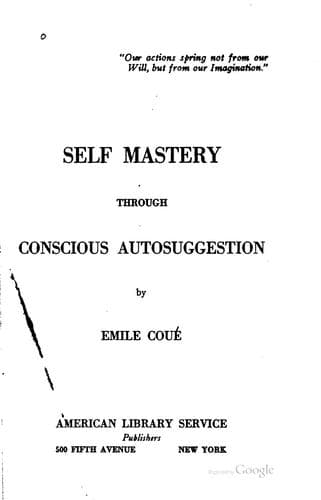
Self Mastery Through Conscious Autosuggestion — John Shaqi
Self Mastery Through Conscious AutosuggestionCoué, Emile
Science
Self Mastery Through Conscious Autosuggestion
Coué, Emile
Mental suggestion
The desire that the teachings of M. Coué in Paris last October should
not be lost to others, has urged me to write them down. Putting aside
this time the numerous people, physically or mentally ill, who have
seen their troubles lessen and disappear as the result of his
beneficent treatment, let us begin by quoting just a few of his
teachings.
_Question._--Why is it that I do not obtain better results although I
use your method and prayer?
_Answer._--Because, probably, at the back of your mind there is an
_unconscious doubt,_ or because you make _efforts._ Now,
remember that efforts are determined by the will; if you bring the
will into play, you run a serious risk of bringing the imagination into
play too, but in the contrary direction, which brings about just the
reverse of what you desire.
_Question._--What are we to do when something troubles us?
_Answer._--When something happens that troubles you, _repeat_ at
once "No, that does not trouble me at all, not in the least, the fact is
rather agreeable than otherwise." In short, the idea is to work
ourselves up in a good sense instead of in a bad.
_Question._--Are the preliminary experiments indispensable if they
are unacceptable to the pride of the subject?
_Answer._--No, they are not indispensable, but they are of great
utility; for although they may seem childish to certain people, they
are on the contrary extremely serious; they do indeed prove three
things:
1. That every idea that we have in our minds becomes _true_ for us,
and has a tendency to transform itself into action.
2. That when there is a conflict between the imagination and the will,
it is always the imagination which wins; and in this case we do
exactly the _contrary_ of what we wish to do.
3. That it is easy for us to put into our minds, _without any effort,_
the idea that we wish to have, since we have been able without effort
to think in succession: "I cannot," and then "I can."
The preliminary experiments should not be repeated at home; alone,
one is often unable to put oneself in the right physical and mental
conditions, there is a risk of failure, and in this case one's
self-confidence is shaken.
_Question._--When one is in pain, one cannot help thinking of one's
trouble.
_Answer._--Do not be afraid to think of it; on the contrary, do think
of it, but to say to it, "I am not _afraid_ of you."
If you go anywhere and a dog rushes at you barking, look it firmly
in the eyes and it will not bite you; but if you fear it, if you turn back,
he will soon have his teeth in your legs.
_Question._--And if one does a retreat?
_Answer._--Go backwards.
_Question._--How can we realize what we desire?
_Answer._--By often repeating what you desire: "I am gaining
assurance," and you will do so; "My memory is improving," and it
really does so; "I am becoming absolutely master of myself," and
you find that you are becoming so.
If you say the contrary, it is the contrary which will come about.
Public-domain text, read in full here on John Shaqi.
Reviews
Reviews
No reviews yet
Be the first to share your thoughts on this work.
Join the Discussion
Join the discussion
Sign in to leave a comment or review.
Sign InorCreate an account