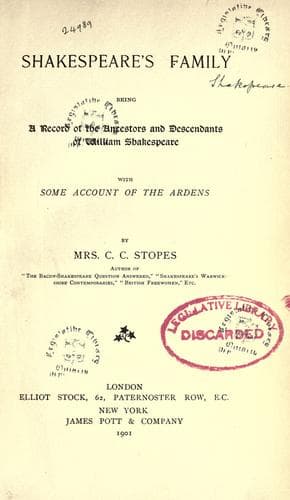
Shakespeare's familyStopes, C. C. (Charlotte Carmichael)
History
Shakespeare's family
Stopes, C. C. (Charlotte Carmichael)
Arden family; Shakespeare family; Shakespeare, William, 1564-1616 -- Family
It was the custom for the Corporation then to make complimentary
offerings of wine to those whom they wished to honour, and thus they
honoured an itinerant preacher, quartered at New Place, in the spring of
1614, with a quart of sack and another of claret, and this has been
supposed to prove that the poet had turned Puritan. John Combe, one of
the chief men of the neighbourhood, died in July, 1614, leaving
Shakespeare L5. Shakespeare would probably never receive it. The will,
dated January 28, 1612-13, was not proved till November, 1616. It is
clear, however, that these men were friendly at that time, and that the
mock elegy, attributed to Shakespeare, could not then have been written,
or, if written, was only laughed at. The Globe Theatre was rebuilt at
great cost that year. Chamberlain, writing to a lady in Venice, said: "I
hear much speech of this new playhouse, which is sayde to be the fayrest
that ever was in England" (June 30, 1614).
In the same year, William Combe, the new Squire of Welcombe, attempted
enclosure of some of the common fields, a design resisted by the
Corporation. This scheme materially affected Shakespeare through his
tithes, and much discussion has been waged over the true meaning of
the entries of his cousin, Thomas Green, the Town Clerk of
Stratford-on-Avon, and his attorney. Unfortunately, these are badly
written, and the composition is dubious; but to my mind it seems clear
that Green meant to say that Mr. Shakespeare could not bear the
enclosing of Welcombe.[169]
In the opening of 1615-16 Shakespeare found himself "in perfect healthe
and memorie--God be praised"; and yet, for some reason, he wished to
make a new will, "revoking all other wills," and his solicitor, Francis
Collins of Warwick, drew up a draft. Halliwell-Phillipps thinks this was
done in January, and that it was intended to have been signed on the
25th of that month. I own that the date, erased to be replaced by
"March," looks to me more like "February." An important difference it
would be, because in January he might not have known that his daughter,
Judith Shakespeare, aged 32, had made up her mind to marry Thomas
Quiney, aged 28. By February 25 she had already done it. On February 10,
1616, Thomas Quiney was married, at Stratford-on-Avon, to Judith
Shakespeare without a license, an irregularity for which both the
parties were summoned to appear[170] before the Ecclesiastical Courts
some weeks afterwards, and threatened with excommunication, but probably
the fact of Shakespeare's illness and death would act as an excuse in
high quarters.
Public-domain text, read in full here on John Shaqi.
Reviews
Reviews
No reviews yet
Be the first to share your thoughts on this work.
Join the Discussion
Join the discussion
Sign in to leave a comment or review.
Sign InorCreate an account