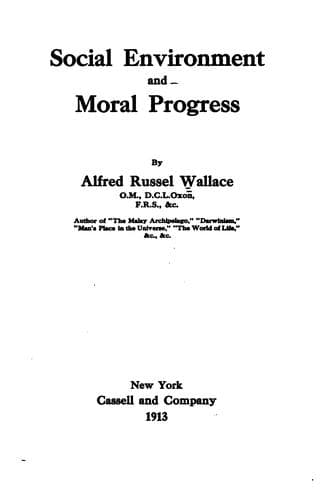
Social Environment and Moral ProgressWallace, Alfred Russel
Philosophy
Social Environment and Moral Progress
Wallace, Alfred Russel
Natural selection; Social ethics
But this latter period was also a period of a great uprising of the
specially human virtues of justice, of pity, of the love of freedom,
and of the importance of education; and though the rapid increase of
wealth through the utilisation of natural forces led to all the evils
due to the unchecked growth of individual riches and power, yet these
very evils in all their intensity and horror were perhaps necessary to
excite in a sufficient number of minds the determination to get rid of
them. Time was also required for the workers to learn their own power,
and, very gradually, to learn how to use it. The rick-burning and
machine-breaking of the early part of the century have been succeeded
by combination and strikes; step by step political power has been
gained by the masses; but only now, in the twentieth century, are they
beginning to learn how to use their strength in an effective manner.
There are, however, indications that the whole march of progress has
been dangerously rapid, and it _might_ have been safer if the great
increases of knowledge and the vast accumulations of wealth had been
spread over two centuries instead of one. In that case our higher
nature might have been able to keep pace with the growing evils of
superfluous wealth and increasing luxury, and it might have been
possible to put a check upon them before they had attained the full
power for evil they now possess.
Nevertheless, the omens for the future are good. The great body of the
more intelligent workers are determined to have JUSTICE. They
insist upon the abolition of monopolies of the forces of nature, and
upon the gradual admission of all to _equal opportunities_ for labour
by free access to their native soil. Thus may be initiated the birth of
a new era of peaceful reform and moral advancement.
NOTE.—As many of my readers may not understand the allusions
in the second verse of Mr. Dell's poem (pp. 117-118), I append
the explanation:
"The Porch," the place where the Stoic philosophers taught—The
Painted Porch in Athens.
"The Garden," scene of Plato's and Socrates' teaching.
Zeno was the founder of the Stoic philosophy.
Pyrrho was the founder of the Sceptic school.
Philip of Macedon lost an eye at the siege of Methone by a
slinger's pebble.
Melitus was one of the disputants with Socrates, and was always
vanquished by him.
Dionysius, the Tyrant of Syracuse, was also a Poet and was a
candidate for the prize at the Olympic games, but was conquered
and therefore feared the more skilful "stylus" (pen) of the
victors.
Tyrtæus, a lame schoolmaster of Athens, inspired the
Lacedæmonians by his patriotic war-songs, and thus contributed
largely to their victories.
CHAPTER XVI
MORAL PROGRESS THROUGH A NEW FORM OF SELECTION
Public-domain text, read in full here on John Shaqi.
Reviews
Reviews
No reviews yet
Be the first to share your thoughts on this work.
Join the Discussion
Join the discussion
Sign in to leave a comment or review.
Sign InorCreate an account