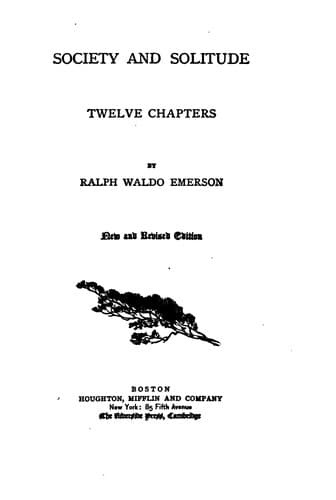
Society and solitude: Twelve chaptersEmerson, Ralph Waldo
Philosophy
Society and solitude: Twelve chapters
Emerson, Ralph Waldo
American essays -- 19th century
The difficulties to be overcome must be freely admitted; they are
many and great. Nor are they to be disposed of by any criticism
or amendment of particulars taken one at a time, but only by the
arrangement of the household to a higher end than those to which our
dwellings are usually built and furnished. And is there any calamity
more grave, or that more invokes the best good-will to remove it,
than this?--to go from chamber to chamber, and see no beauty; to find
in the housemates no aim; to hear an endless chatter and blast; to be
compelled to criticise; to hear only to dissent and to be disgusted;
to find no invitation to what is good in us, and no receptacle for
what is wise;--this is a great price to pay for sweet bread and warm
lodging,--being defrauded of affinity, of repose, of genial culture,
and the inmost presence of beauty.
It is a sufficient accusation of our ways of living, and certainly
ought to open our ear to every good-minded reformer, that our idea of
domestic well-being now needs wealth to execute it. Give me the means,
says the wife, and your house shall not annoy your taste nor waste
your time. On hearing this, we understand how these Means have come
to be so omnipotent on earth. And indeed the love of wealth seems to
grow chiefly out of the root of the love of the Beautiful. The desire
of gold is not for gold. It is not the love of much wheat and wool
and household-stuff. It is the means of freedom and benefit. We scorn
shifts; we desire the elegance of munificence; we desire at least to
put no stint or limit on our parents, relatives, guests, or dependents;
we desire to play the benefactor and the prince with our townsmen, with
the stranger at the gate, with the bard, or the beauty, with the man
or woman of worth, who alights at our door. How can we do this, if the
wants of each day imprison us in lucrative labors, and constrain us to
a continual vigilance lest we be betrayed into expense?
Public-domain text, read in full here on John Shaqi.
Reviews
Reviews
No reviews yet
Be the first to share your thoughts on this work.
Join the Discussion
Join the discussion
Sign in to leave a comment or review.
Sign InorCreate an account