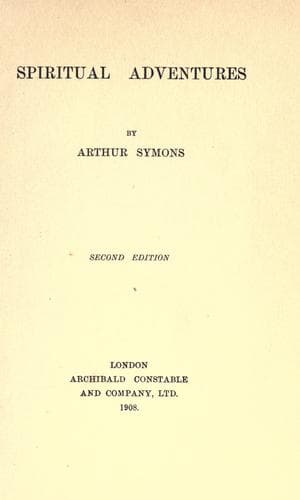
Great Britain -- Social life and customs -- 19th century -- Fiction; Short stories
Waydelin lay shivering and quaking on the bed; he seemed very conscious
and wholly preoccupied with himself. He never looked at the woman as she
flung herself on the floor by the bedside and began to cry out to him
and kiss his hand. The tears ran down over her cheeks, leaving ghastly
furrows in the wet powder, which clotted and caked under them. The curl
was beginning to come out of her too yellow hair, which straggled in
wisps about her ears. She sobbed in gulps, and entreated him to look at
her and forgive her. At that he looked, and as he looked life seemed to
revive in his eyes. He motioned to me to lift him up. I lifted him
against the pillows, and in a weak voice he asked me for drawing-paper
and a pencil. 'Don't move,' he said to his wife, who knelt there struck
into rigid astonishment, with terror and incomprehension in her eyes.
The pose, its grotesque horror, were finer than the finest of his
inventions. He made a few scrawls on the paper, trying to fix that last
and best pose of his model. But he could no longer guide the pencil, and
he let it drop out of his hand with a look of helplessness, almost of
despair, and sank down in the bed and shut his eyes. He did not open
them again. The doctor came, and tried all means to revive him, but
without success. Something in him seemed consciously to refuse to come
back to life. He lay for some time, dying slowly, with his eyes fast
shut, and it was only when the doctor had felt his heart and found no
movement that he knew he was dead.
AN AUTUMN CITY.
To Daniel Roserra life was a matter of careful cultivation. He respected
nature, for what might be cunningly extracted from nature; provided only
that one's aim was a quite personal thing, willingly subject to
surroundings on its way to the working out of itself. He tended his soul
as one might tend some rare plant; careful above most things of the
earth it was to take root in. And so he thought much of the influence of
places, of the image a place makes for itself in the consciousness, of
all that it might do in the formation of a beautiful or uncomely
disposition. Places had virtues of their own for him; he supposed that
he had the quality of divining their secrets; at all events, if they
were places to which he could possibly be sensitive. Much of his time
was spent in travelling, in a leisurely way, about Europe; not for the
sake of seeing anything in particular, for he had no interest in
historical associations or in the remains of ugly things that happened
to be old, or in visiting the bric-a-brac museums of the fine arts which
make some of the more tolerable countries tedious. He chose a city, a
village, or a seashore for its charm, its appeal to him personally;
nothing else mattered.
Public-domain text, read in full here on John Shaqi.
Reviews
Reviews
No reviews yet
Be the first to share your thoughts on this work.
Join the Discussion
Join the discussion
Sign in to leave a comment or review.
Sign InorCreate an account