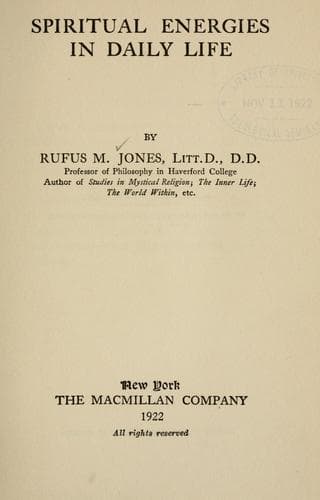
Spiritual Energies in Daily LifeJones, Rufus M. (Rufus Matthew)
Religion
Spiritual Energies in Daily Life
Jones, Rufus M. (Rufus Matthew)
Spiritual life
If he is an Amos, he will refuse to fall in line with the easy worshipers
of his age, who are satisfied with the old-time religion of “burnt
offerings” and “meat offerings” and “peace offerings of fat beasts.” His
soul will cry out for a religion which makes a new moral and spiritual
man, “makes righteousness run down as a mighty stream,” and sets the
worshiper into new social relations with his fellows. If he is an Isaiah,
he will refuse “to tramp the temple” with the mass of easy worshipers;
he will have his own vision of “the Lord high and lifted up,” with his
glory filling not only the temple but the whole earth, and he will
dedicate himself to the task of preparing a holy people and a holy city
for this God who has been revealed to him as a thrice-holy God. If he is
a Jeremiah, he will not accept the view that the traditional religion of
Jerusalem is adequate for the crisis of the times. He will insist that
true religion must be inwardly experienced; that the law of God must be
written in the heart, and that the life of a man must be the living
fruit of his faith. He will cry out against the idea that the moral
wounds and spiritual sores of the daughter of Jerusalem can be healed
with easy salves and cheap panaceas.
The supreme example of this refusal to go along the easy line of
contemporary religion is that of One who was more than a prophet. His
people prided themselves on being the chosen people of the Lord. The
scribal leaders had succeeded in drawing up a complete and perfect
catalogue of religious performances. They supplied minute directions for
one’s religious duty in every detail, real or imaginary, of daily life,
and the world has never seen a more elaborate form of religion than this
of the Pharisees. But Christ refused to follow the path of custom; he
could not and he would not do the things which the scribes prescribed. He
broke a new path for the soul, and called men away from legalism and the
dead routine of “performances” to a life of individual faith and service,
which involves suffering and self-sacrifice, but which brings the soul
into personal relation with the living God.
Public-domain text, read in full here on John Shaqi.
Reviews
Reviews
No reviews yet
Be the first to share your thoughts on this work.
Join the Discussion
Join the discussion
Sign in to leave a comment or review.
Sign InorCreate an account