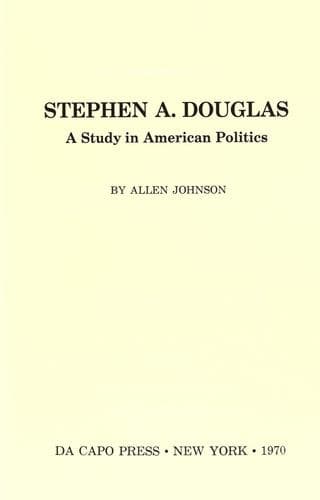
Stephen A. Douglas: A Study in American PoliticsJohnson, Allen
History
Stephen A. Douglas: A Study in American Politics
Johnson, Allen
Douglas, Stephen A. (Stephen Arnold), 1813-1861
Upon one auditor, who to be sure was inexpressibly bored by the whole
discussion of the "everlasting general ticket elections," Douglas made
an unhappy impression. John Quincy Adams recorded in his diary,--that
diary which was becoming a sort of Rogues' Gallery: "He now raved out
his hour in abusive invectives upon the members who had pointed out
its slanders and upon the Whig party. His face was convulsed, his
gesticulation frantic, and he lashed himself into such a heat that if
his body had been made of combustible matter, it would have burnt out.
In the midst of his roaring, to save himself from choking, he stripped
off and cast away his cravat, and unbuttoned his waist-coat, and had
the air and aspect of a half-naked pugilist. And this man comes from a
judicial bench, and passes for an eloquent orator."[174]
No one will mistake this for an impartial description. Nearly every
Democrat who spoke upon this tedious question, according to Adams,
either "raved" or "foamed at the mouth." The old gentleman was too
wearied and disgusted with the affair to be a fair reporter. But as a
caricature, this picture of the young man from Illinois certainly hits
off the style which he affected, in common with most Western orators.
Notwithstanding his very substantial services to his party, Douglas
had sooner or later to face his constituents with an answer to the
crucial question, "What have you done for us?" It is a hard, brutal
question, which has blighted many a promising career in American
politics. The interest which Douglas exhibited in the Western Harbors
bill was due, in part at least, to his desire to propitiate those by
virtue of whose suffrages he was a member of the House of
Representatives. At the same time, he was no doubt sincerely devoted
to the measure, because he believed profoundly in its national
character. Local and national interests were so inseparable in his
mind, that he could urge the improvement of the Illinois River as a
truly national undertaking. "Through this channel, and this alone," he
declared all aglow with enthusiasm, "we have a connected and
uninterrupted navigation for steamboats and large vessels from the
Atlantic Ocean and the Gulf of Mexico, to all the northern lakes."
Considerations of war and defense, as well as of peace and commerce,
counselled the proposed expenditure. "We have no fleet upon the lakes;
we have no navy-yard there at which we could construct one, and no
channel through which we could introduce our vessels from the
sea-board. In times of war, those lakes must be defended, if defended
at all, by a fleet from the naval depot and a yard on the Mississippi
River." After the State of Illinois had expended millions on the
Illinois and Michigan canal, was Congress to begrudge a few thousands
to remove the sand-bars which impeded navigation in this "national
highway by an irrevocable ordinance"?[175]
Public-domain text, read in full here on John Shaqi.
Reviews
Reviews
No reviews yet
Be the first to share your thoughts on this work.
Join the Discussion
Join the discussion
Sign in to leave a comment or review.
Sign InorCreate an account