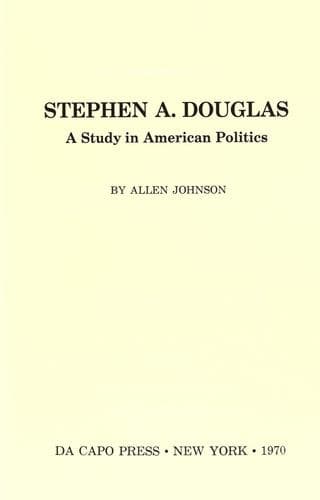
Stephen A. Douglas: A Study in American PoliticsJohnson, Allen
History
Stephen A. Douglas: A Study in American Politics
Johnson, Allen
Douglas, Stephen A. (Stephen Arnold), 1813-1861
"Governor Clay, of Alabama, was near General Jackson, who was himself
sitting on a sofa in the hall, and as each person entered, the
governor introduced him to the hero and he passed along. When Judge
Douglas was thus introduced, General Jackson raised his still
brilliant eyes and gazed for a moment in the countenance of the judge,
still retaining his hand. 'Are you the Mr. Douglas, of Illinois, who
delivered a speech last session on the subject of the fine imposed on
me for declaring martial law at New Orleans?'" asked General Jackson.
"'I have delivered a speech in the House of Representatives upon that
subject,' was the modest reply of our friend.
"'Then stop,' said General Jackson; 'sit down here beside me. I desire
to return you my thanks for that speech. You are the first man that
has ever relieved my mind on a subject which has rested upon it for
thirty years. My enemies have always charged me with violating the
Constitution of my country by declaring martial law at New Orleans,
and my friends have always admitted the violation, but have contended
that circumstances justified me in that violation. I never could
understand how it was that the performance of a solemn duty to my
country--a duty which, if I had neglected, would have made me a
traitor in the sight of God and man, could properly be pronounced a
violation of the Constitution. I felt convinced in my own mind that I
was not guilty of such a heinous offense; but I could never make out a
legal justification of my course, nor has it ever been done, sir,
until you, on the floor of Congress, at the late session, established
it beyond the possibility of cavil or doubt. I thank you, sir, for
that speech. It has relieved my mind from the only circumstance that
rested painfully upon it. Throughout my whole life I never performed
an official act which I viewed as a violation of the Constitution of
my country; and I can now go down to the grave in peace, with the
perfect consciousness that I have not broken, at any period of my
life, the Constitution or laws of my country.'
"Thus spoke the old hero, his countenance brightened by emotions which
it is impossible for us to describe. We turned to look at Douglas--he
was speechless. He could not reply, but convulsively shaking the aged
veteran's hand, he rose and left the hall. Certainly General Jackson
had paid him the highest compliment he could have bestowed on any
individual."[184]
When the August elections had come and gone, Douglas found himself
re-elected by a majority of fourteen hundred votes and by a plurality
over his Whig opponent of more than seventeen hundred.[185] He was to
have another opportunity to serve his constituents; but the question
was still open, whether his talents were only those of an adroit
politician intent upon his own advancement, or those of a statesman,
capable of conceiving generous national policies which would efface
the eager ambitions of the individual and the grosser ends of party.
Public-domain text, read in full here on John Shaqi.
Reviews
Reviews
No reviews yet
Be the first to share your thoughts on this work.
Join the Discussion
Join the discussion
Sign in to leave a comment or review.
Sign InorCreate an account