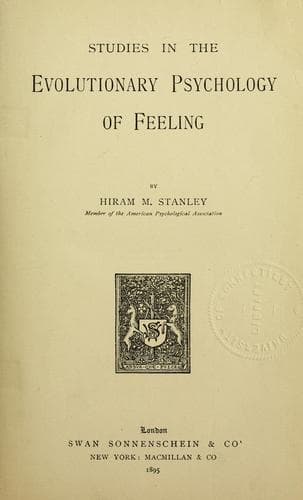
Studies in the Evolutionary Psychology of FeelingStanley, Hiram Miner
Philosophy
Studies in the Evolutionary Psychology of Feeling
Stanley, Hiram Miner
Emotions
experience. In early and even in later consciousness it is probable that
the majority of pleasures and pains are so dull in intensity that they
do not rouse sensation, and comparatively few incite as far as to
perception. A close analysis of our own consciousness even will show
many pleasures and pains, many vague states of uneasiness and
discomfort, and many of organic pleasure and comfort, which lead to
nothing and come to nothing for either sensation or perception. These
states stand alone by themselves, and vanish with little effect on
either mind or body. They constitute the outer fringe of consciousness
where all mentality starts, and under sufficient pressure of
life-interest develops into great fulness and complexity, or, when of
comparatively little value to the organism, they disappear suddenly and
completely. I am inclined also to think that close scrutiny will
sometimes reveal for psychical life, as for the physical, certain
entirely useless survivals, undifferentiated feelings of some types, and
probably also some pure sensations.
I conceive then that the fundamental order of consciousness is not, as
usually set forth, pure sensation with accompanying pleasure and pain,
but the reverse—pure pleasure and pain with accompanying sensation; and
only by a very gradual evolution indeed did pure feeling bring in
sensation, which is thus always sequent and not accompaniment. We
commonly inquire as to a sensation, Was it pleasurable or painful? but
the true form of inquiry is, Was the pain or pleasure senseful? Did it
attain to bringing in the qualifying element of a sensation, and in what
form?
Public-domain text, read in full here on John Shaqi.
Reviews
Reviews
No reviews yet
Be the first to share your thoughts on this work.
Join the Discussion
Join the discussion
Sign in to leave a comment or review.
Sign InorCreate an account