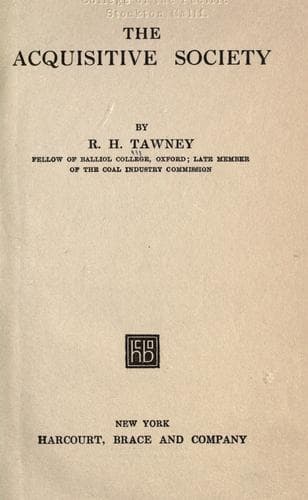
The Acquisitive SocietyTawney, R. H. (Richard Henry)
Philosophy
The Acquisitive Society
Tawney, R. H. (Richard Henry)
Economics; Industries; Social problems
The alchemy by which a gentleman who has never seen a coal mine
distills the contents of that place of gloom into elegant chambers in
London and a place in the country is not the monopoly of royalty
owners. A similar feat of prestidigitation is performed by the {89}
owner of urban ground-rents. In rural districts some landlords,
perhaps many landlords, are partners in the hazardous and difficult
business of agriculture, and, though they may often exercise a power
which is socially excessive, the position which they hold and the
income which they receive are, in part at last, a return for the
functions which they perform. The ownership of urban land has been
refined till of that crude ore only the pure gold is left. It is the
perfect sinecure, for the only function it involves is that of
collecting its profits, and in an age when the struggle of Liberalism
against sinecures was still sufficiently recent to stir some chords of
memory, the last and greatest of liberal thinkers drew the obvious
deduction. "The reasons which form the justification ... of property
in land," wrote Mill in 1848, "are valid only in so far as the
proprietor of land is its improver.... In no sound theory of private
property was it ever contemplated that the proprietor of land should be
merely a sinecurist quartered on it." Urban ground-rents and royalties
are, in fact, as the Prime Minister in his unregenerate days suggested,
a tax which some persons are permitted by the law to levy upon the
industry of others. They differ from public taxation only in that
their amount increases in proportion not to the nation's need of
revenue but to its need of the coal and space on which they are levied,
that their growth inures to private gain not to public benefit, and
that if the proceeds are wasted on frivolous expenditure no one has any
right to complain, because the arrangement by which Lord Smith spends
wealth produced by Mr. Brown on objects which do no good to either is
part {90} of the system which, under the name of private property, Mr.
Brown as well as Lord Smith have learned to regard as essential to the
higher welfare of mankind.
Public-domain text, read in full here on John Shaqi.
Reviews
Reviews
No reviews yet
Be the first to share your thoughts on this work.
Join the Discussion
Join the discussion
Sign in to leave a comment or review.
Sign InorCreate an account