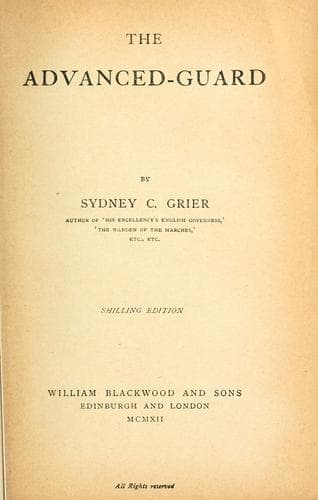
British -- Asia -- Fiction; Man-woman relationships -- Fiction; Soldiers -- Fiction
Sir Dugald smiled with some difficulty, for his face had grown tense.
“You are the only man who would say such things to me, Major Keeling,
and the only man I would allow to do it. With you I have no choice.”
“No, no; I beg your pardon. That abominable coolness of yours--but I
shall be insulting you again if I don’t look out. But if you had sat
listening to that villain for an hour, while he depicted Nalapur as a
perfect hell on earth, and Wilayat Ali as a wholly suitable ruler for
it, and then at last brought things round to the point he had been
aiming at all along, but which I had never seen, you’d know something
of what I feel. Why, the fellow had the inconceivable impudence to say
that he thought I understood all the time what he was driving at, and
only held back so as to make certain that he put himself completely in
my power!”
“But he could never have thought we should set a Hindu over a
Mohammedan state.”
“What have we done in Kashmir?”
“But Nalapur is outside our borders. We don’t claim any right to
interfere in their choice of a ruler.”
“Whether we claim it or not, we have interfered already. It was before
your time, of course, just after that wretched expedition to Ethiopia,
where we ought never to have gone, but having gone, we should have
stayed. Nasr Ali was Amir then, and his behaviour throughout was most
correct, even when our fortunes were at the lowest. Unfortunately for
him, it was thought well that the General and he should meet, so that
he might be thanked for his loyalty, and a halt was made for the
purpose. Things went wrong from that moment. The General and his
escort were attacked by tribesmen in one of the passes, and when they
got through, with some loss, the news came that Nasr Ali was ill, and
not able to meet them. You know what Old Harry is, and how he was
likely to receive such a message after the impudence of the tribes;
and just as he was working himself up into a fine fury there came to
his camp in disguise these two scoundrels, Gobind Chand and Wilayat
Ali, the Amir’s brother. They made out that they had stolen away at
the risk of their lives to warn the General that Nasr Ali meant to
murder him and the whole escort. Sir Henry didn’t wait to inquire why
Nasr Ali should choose the time when a victorious army was within call
to assassinate its leader, for the fugitives’ news just fitted in with
his own suspicions. They gave him a sign by which he was to judge of
their good faith. Nasr Ali had promised to receive the mission at the
gate of the city the following day: if he did not appear, that would
be proof of his treachery. Sir Henry sent an order back to the army
for a brigade to be in readiness, and waited. Sure enough, before they
reached the city gate Wilayat Ali, in his own person this time, came
to meet them and say that his brother was too ill to come out, but
would receive them in the _killa_ [palace] if they would enter the
city. To Sir Henry, and all who remembered the Ethiopian business, it
Public-domain text, read in full here on John Shaqi.
Reviews
Reviews
No reviews yet
Be the first to share your thoughts on this work.
Join the Discussion
Join the discussion
Sign in to leave a comment or review.
Sign InorCreate an account