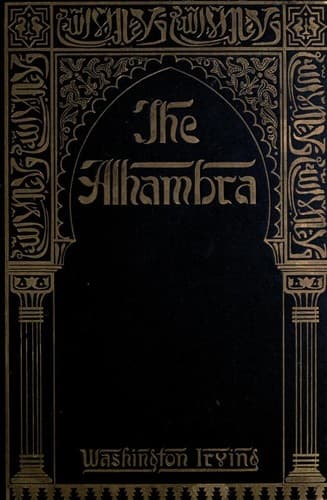
Verhalen over het gebouwencomplex in Granada, dat eigendom was van de laatste islamitische vorsten in Spanje.
The Moors of Granada regarded the Alhambra as a miracle of art, and had
a tradition that the king who founded it dealt in magic, or at least in
alchemy, by means whereof he procured the immense sums of gold expended
in its erection. A brief view of his reign will show the secret of his
wealth. He is known in Arabian history as Muhamed Ibn-l-Ahmar; but his
name in general is written simply Alhamar, and was given to him, we are
told, on account of his ruddy complexion.[5]
He was of the noble and opulent line of the Beni Nasar, or tribe of
Nasar, and was born in Arjona, in the year of the Hegira 592 (A.D.
1195). At his birth the astrologers, we are told, cast his horoscope
according to Oriental custom, and pronounced it highly auspicious; and a
santon predicted for him a glorious career. No expense was spared in
fitting him for the high destinies prognosticated. Before he attained
the full years of manhood, the famous battle of the Navas (or plains) of
Tolosa shattered the Moorish empire, and eventually severed the Moslems
of Spain from the Moslems of Africa. Factions soon arose among the
former, headed by warlike chiefs ambitious of grasping the sovereignty
of the Peninsula. Alhamar became engaged in these wars; he was the
general and leader of the Beni Nasar, and, as such, he opposed and
thwarted the ambition of Aben Hud, who had raised his standard among
the warlike mountains of the Alpuxaras, and been proclaimed king of
Murcia and Granada. Many conflicts took place between these warring
chieftains; Alhamar dispossessed his rival of several important places,
and was proclaimed king of Jaen by his soldiery; but he aspired to the
sovereignty of the whole of Andalusia, for he was of a sanguine spirit
and lofty ambition. His valor and generosity went hand in hand; what he
gained by the one he secured by the other; and at the death of Aben Hud
(A.D. 1238) he became sovereign of all the territories which owed
allegiance to that powerful chief. He made his formal entry into Granada
in the same year, amid the enthusiastic shouts of the multitude, who
hailed him as the only one capable of uniting the various factions which
prevailed, and which threatened to lay the empire at the mercy of the
Christian princes.
Public-domain text, read in full here on John Shaqi.
Reviews
Reviews
No reviews yet
Be the first to share your thoughts on this work.
Join the Discussion
Join the discussion
Sign in to leave a comment or review.
Sign InorCreate an account