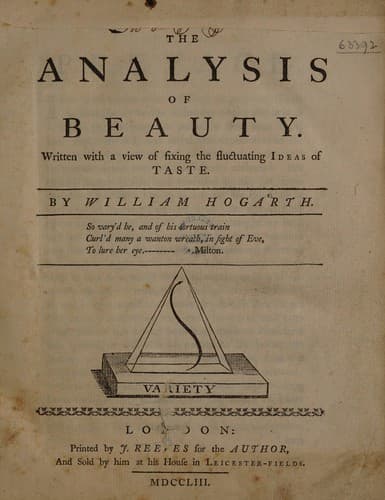
The Analysis of Beauty: Written with a view of fixing the fluctuating ideas of taste — John Shaqi
The Analysis of Beauty: Written with a view of fixing the fluctuating ideas of tasteHogarth, William
Philosophy
The Analysis of Beauty: Written with a view of fixing the fluctuating ideas of taste
Hogarth, William
Aesthetics -- Early works to 1800
If so, certainly it is in the power of a man of science, with as
observing an eye, to go still further, and conceive, with a very
little turn of thought, many other necessary circumstances concerning
proportion, as of what size and in what manner the bones help to make
up the bulk, and support the other parts; as well as what certain
weights or dimensions of muscles are proper (according to the principle
of the steelyard) to move such or such a length of arm with this or
that degree of swiftness or force.
But though much of this matter, may be easily understood by common
observation, assisted by science, still I fear it will be difficult to
raise a very clear idea of what constitutes, or composes the _utmost
beauty of proportion_; such as is seen in the Antinous; which is
allowed to be the most perfect in this respect, of any of the antique
statues; and tho' the lovely likewise seems to have been as much the
sculptor's aim, as in the Venus; yet a manly strength in its proportion
is equally express'd from head to foot in it.
[Illustration: Fig. 6]
Let us try, however, and as this master-piece of art is so well known,
we will set it up before us as a pattern, and endeavour to fabricate,
or put together in the mind, such kind of parts as shall seem to build
another figure like it. In doing which, we shall soon find that it is
chiefly to be effected by means of the nice sensation we naturally
have of what certain quantities or dimensions of parts, are fittest to
produce the utmost strength for moving, or supporting great weights;
and of what are most fit for the utmost light agility, as also for
every degree, between these two extremes.
He who hath best perfected his ideas of these matters by common
observations, and by the assistance of arts relative thereto,
will probably be most precisely just and clear, in conceiving the
application of the various parts and dimensions, that will occur to
him, in the following descriptive manner of disposing of them, in order
to form the idea of a fine-proportion'd figure.
Having set up the Antinous as our pattern, we will suppose there were
placed on one side of it, the unwieldy elephant-like figure of an
Atlas, made up of such thick bones and muscles, as would best fit him
for supporting a vast weight, according to his character of extreme
heavy strength. And, on the other side, imagine the slim figure of a
Mercury, every where neatly formed for the utmost light agility, with
slender bones and taper muscles fit for his nimble bounding from the
ground.--Both these figures must be supposed of equal height, and not
exceeding six foot[8].
[8] If the scale of either of these proportions were to exceed six
foot in the life, the quality of strength in one, and agility in the
other, would gradually decrease, the larger the person grew. There are
sufficient proofs of this, both from mechanical reasonings and common
observation.
Public-domain text, read in full here on John Shaqi.
Reviews
Reviews
No reviews yet
Be the first to share your thoughts on this work.
Join the Discussion
Join the discussion
Sign in to leave a comment or review.
Sign InorCreate an account