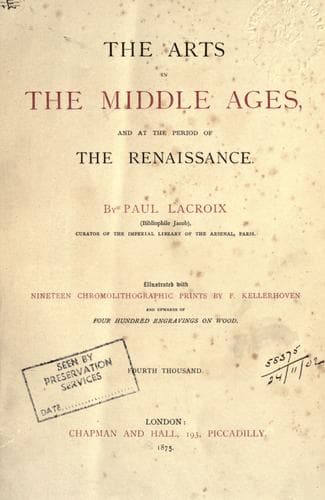
The Arts in the Middle Ages and at the Period of the Renaissance — John Shaqi
The Arts in the Middle Ages and at the Period of the RenaissanceJacob, P. L.
History
The Arts in the Middle Ages and at the Period of the Renaissance
Jacob, P. L.
Art, Medieval; Art, Renaissance; Middle Ages
In the traditions of the magnificent city of Babylon we also find
figured tapestry delineating the mysteries of religion, and handing
down to us the recollection of historical incidents. “The palace of the
kings of Babylon,” says Philostratus, in the “Life of Apollonius of
Tyana,” “was ornamented with tapestries in gold and silver tissues,
which recorded the Grecian fables of Andromeda, of Orpheus, &c.” The
Greek poet Apollonius of Rhodes, who wrote a century before our era,
relates in his poem of “The Argonauts” that the women of Babylon
excelled in the execution of these gorgeous textures. The famous
tapestries which were sold in the time of Metellus Scipio for 800,000
sesterces (about 165,000 francs), and a hundred years later were
purchased for the exorbitant sum of two million sesterces (about 412,000
francs) by Nero, to place on his festive couches, were of Babylonian
workmanship.
Ancient Egypt, which would seem to have been the early cradle of an
advanced civilisation, was also renowned for this marvellous art, the
invention of which the Greeks attributed to Minerva, and to which
allusion is frequently made in their mythology. Penelope’s web, whereon
were delineated the exploits of Ulysses, has remained the most
celebrated among them all. It was on a similar web that Philomela, in
her prison, illustrated in embroidery the narrative of her misfortunes,
after Tereus had cut out her tongue, to prevent her telling her sister
Progne the outrage she had suffered at his hands.
Throughout the poems of Homer we find embroidery of this kind either
mentioned, or described as made with the needle or loom, and intended
for decorative drapery, or as garments for men and women. During the
siege of Troy, Helen embroidered, upon a fine tissue, the sanguinary
combats of the heroes who were destroying each other for her sake. The
cloak of Ulysses represents a dog pulling down a fawn, &c.
Public-domain text, read in full here on John Shaqi.
Reviews
Reviews
No reviews yet
Be the first to share your thoughts on this work.
Join the Discussion
Join the discussion
Sign in to leave a comment or review.
Sign InorCreate an account