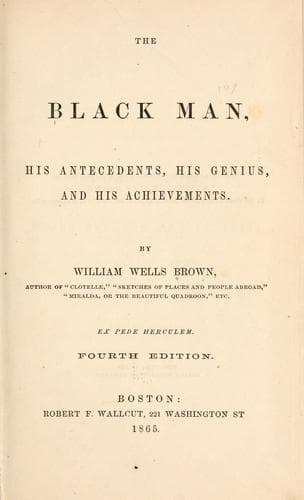
The Black Man: His Antecedents, His Genius, and His AchievementsBrown, William Wells
History
The Black Man: His Antecedents, His Genius, and His Achievements
Brown, William Wells
African Americans -- Biography
Reënforcements came to the whites, and the blacks were overpowered and
defeated by the superior numbers of their enemy. In this battle many
were slain on both sides. Will, the bloodthirsty and revengeful slave,
fell with his broadaxe uplifted, after having laid three of the whites
dead at his feet with his own strong arm and his terrible weapon. His
last words were, "Bury my axe with me." For he religiously believed
that in the next world the blacks would have a contest with the whites,
and that he would need his axe. Nat Turner, after fighting to the last
with his short sword, escaped with some others to the woods near by,
and was not captured for nearly two months. When brought to trial he
pleaded "not guilty;" feeling, as he said, that it was always right
for one to strike for his own liberty. After going through a mere form
of trial, he was convicted and executed at Jerusalem, the county seat
for Southampton county, Virginia. Not a limb trembled or a muscle was
observed to move. Thus died Nat Turner, at the early age of thirty-one
years--a martyr to the freedom of his race, and a victim to his own
fanaticism. He meditated upon the wrongs of his oppressed and injured
people, till the idea of their deliverance excluded all other ideas
from his mind, and he devoted his life to its realization. Every thing
appeared to him a vision, and all favorable omens were signs from
God. That he was sincere in all that he professed, there is not the
slightest doubt. After being defeated he might have escaped to the free
states, but the hope of raising a new band kept him from doing so.
He impressed his image upon the minds of those who once beheld him. His
looks, his sermons, his acts, and his heroism live in the hearts of
his race, on every cotton, sugar, and rice plantation at the south.
The present generation of slaves have a superstitious veneration for
his name, and believe that in another insurrection Nat Turner will
appear and take command. He foretold that at his death the sun would
refuse to shine, and that there would be signs of disapprobation
given from heaven. And it is true that the sun was darkened, a storm
gathered, and more boisterous weather had never appeared in Southampton
county than on the day of Nat's execution. The sheriff, warned by the
prisoner, refused to cut the cord that held the trap. No black man
would touch the rope. A poor old white man, long besotted by drink,
was brought forty miles to be the executioner. And even the planters,
with all their prejudice and hatred, believed him honest and sincere;
for Mr. Gray, who had known Nat from boyhood, and to whom he made his
confession, says of him,--
Public-domain text, read in full here on John Shaqi.
Reviews
Reviews
No reviews yet
Be the first to share your thoughts on this work.
Join the Discussion
Join the discussion
Sign in to leave a comment or review.
Sign InorCreate an account