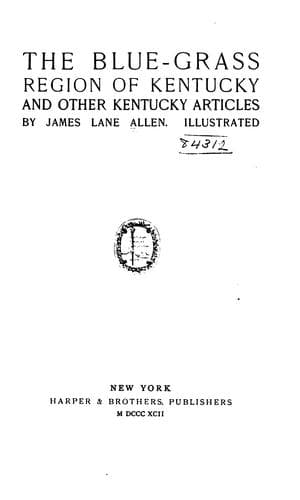
The Blue-Grass Region of Kentucky, and Other Kentucky Articles — John Shaqi
The Blue-Grass Region of Kentucky, and Other Kentucky ArticlesAllen, James Lane
General
The Blue-Grass Region of Kentucky, and Other Kentucky Articles
Allen, James Lane
Kentucky -- Description and travel; Kentucky -- Social life and customs
Attention is fixed on Uncle Tom first as head-servant of the farm. In a
small work on slavery in Kentucky by George Harris, it is stated that
masters chose the cruelest of their negroes for this office. It is not
true, exceptions allowed for. The work would not be worth mentioning,
had not so many people at the North believed it. The amusing thing is,
they believed Mrs. Stowe also. But if Mrs. Stowe's account of slavery in
Kentucky is true, Harris's is not.
It is true that Uncle Tom inspired the other negroes with some degree of
fear. He was censor of morals, and reported derelictions of the lazy,
the destructive, and the thievish. For instance, an Uncle Tom on one
occasion told his master of the stealing of a keg of lard, naming the
thief and the hiding-place. "Say not a word about it," replied his
master. The next day he rode out into the field where the culprit was
ploughing, and, getting down, walked along beside him. "What's the
matter, William?" he asked, after a while; "you can't look me in the
face as usual." William burst into tears, and confessed everything.
"Come to-night, and I will arrange so that you can put the lard back and
nobody will ever know you took it." The only punishment was a little
moral teaching; but the Uncle Tom in the case, though he kept his
secret, looked for some days as though the dignity of his office had not
been suitably upheld by his master.
It was Uncle Tom's duty to get the others off to work in the morning.
In the fields he did not drive the work, but led it--being a
master-workman--led the cradles and the reaping-hooks, the hemp-breaking
and the corn-shucking. The spirit of happy music went with the workers.
They were not goaded through their daily tasks by the spur of pitiless
husbandry. Nothing was more common than their voluntary contests of
skill and power. My recollection reaches only to the last two or three
years of slavery; but I remember the excitement with which I witnessed
some of these hard-fought battles of the negroes. Rival hemp-breakers of
the neighborhood, meeting in the same field, would slip out long before
breakfast and sometimes never stop for dinner. So it was with cradling,
corn-shucking, or corn-cutting--in all work where rivalries were
possible. No doubt there were other motives. So much work was a day's
task; for more there was extra pay. A capital hand, by often performing
double or treble the required amount, would clear a neat profit in a
season. The days of severest labor fell naturally in harvest-time. But
then intervals of rest in the shade were commonly given; and milk,
coffee, or, when the prejudice of the master did not prevent (which was
not often), whiskey was distributed between meal-times. As a rule they
worked without hurry. De Tocqueville gave unintentional testimony to
characteristic slavery in Kentucky when he described the negroes as
"loitering" in the fields. On one occasion the hands dropped work to run
after a rabbit the dogs had started.
Public-domain text, read in full here on John Shaqi.
Reviews
Reviews
No reviews yet
Be the first to share your thoughts on this work.
Join the Discussion
Join the discussion
Sign in to leave a comment or review.
Sign InorCreate an account