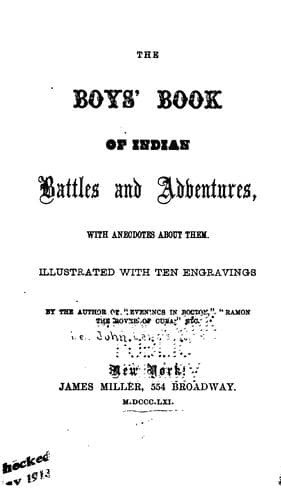
The boys' book of Indian battles and adventures, with anecdotes about them
History
The boys' book of Indian battles and adventures, with anecdotes about them
Indians of North America -- Anecdotes
But the war began to draw to a close: Quanonchet, venturing out with a
few followers near the enemy, was pursued and taken. His behaviour under
his misfortunes was very noble and affecting; for when repeated offers
were made him of life, if he would deliver up Philip, and submit his
own people to the English, he proudly rejected them. They condemned him
to die, and, by a refinement of cruelty, by the hands of three young
Indian chiefs. The heroic man said, “that he liked it well, for he should
die before his heart was soft, or he had spoken any thing unworthy of
himself.”
Philip was deeply moved by the death of the chieftain, for their
friendship was like that of David and Jonathan, strongest in misery and
exile. He was not yet left desolate: his beloved wife and only child
were with him. They had shared all his sufferings; in his flights, his
inroads, his dwellings in the swamps, they seem never to have left his
side. The unfortunate prince now returned to Mount Hope, the scene of
his former power and happiness; it was for no purpose of defence that he
came, for it was too near the English settlements, but merely to visit
it once more. “He finds it,” says Mather, “to be Mount Misery, Mount
Confusion!”
No doubt it was so to his bleeding spirit; for, with all his savage
propensities, this prince was susceptible of some of the finest feelings
of our nature. He sat down mournfully on the beautiful Mount, on which
were now the ruins of his fortress and camp; but he could not remain long
here, for the feet of his pursuers were nigh, and he was compelled to
seek his distant retreats again:—there was a greater agony in store for
him than the sight of his ruined home.
Early one morning, his quarters were surprised by the English, most of
his followers slain, and his wife and son made captive. The chief fled,
broken-hearted, but unsubdued, leaving all he loved on earth in the hands
of those who had no mercy. “This was no small torment to him,” quaintly
says the historian. “Wo to him that spoileth! His peag, or silver belt,
the ensign of his princedom, also remained in our hands, so hardly did he
escape.” The measure of his woes was not yet full. The Indian princess of
Pocasset was warmly attached to his cause, and had more than once aided
him in his extremity; she had received him beneath her roof, soothed his
sorrows, and, what was more, summoned her people to fight for him; and
saved him and his people in her canoes the year before. Now, she followed
him in his flight, and, as the more devout said, as if by a judgment,
could not find a canoe to transport her, and, venturing over the river
upon a raft, it broke under her, and she was drowned. Her body was soon
after washed on shore, and the English, forgetful of all decency and
delicacy to a woman of her rank, though a savage, cut off her head, and
placed it on high, which, when the Indians who were her people saw, they
gathered round, and gave way to the most sad and touching lamentations.
Public-domain text, read in full here on John Shaqi.
Reviews
Reviews
No reviews yet
Be the first to share your thoughts on this work.
Join the Discussion
Join the discussion
Sign in to leave a comment or review.
Sign InorCreate an account