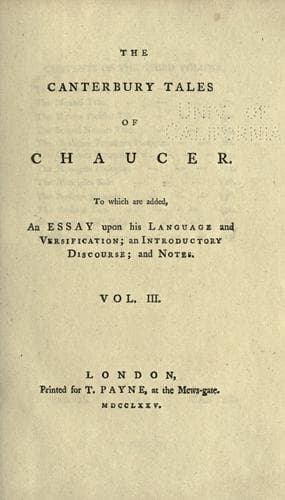
The Canterbury Tales, and Other PoemsChaucer, Geoffrey
ReligionChristian
The Canterbury Tales, and Other Poems
Chaucer, Geoffrey
Chaucer, Geoffrey, -1400; Christian pilgrims and pilgrimages -- Poetry; English poetry -- Middle English, 1100-1500
With him there rode a gentle PARDONERE <55>
Of Ronceval, his friend and his compere,
That straight was comen from the court of Rome.
Full loud he sang, “Come hither, love, to me”
This Sompnour *bare to him a stiff burdoun*, *sang the bass*
Was never trump of half so great a soun’.
This Pardoner had hair as yellow as wax,
But smooth it hung, as doth a strike* of flax: *strip
By ounces hung his lockes that he had,
And therewith he his shoulders oversprad.
Full thin it lay, by culpons* one and one, *locks, shreds
But hood for jollity, he weared none,
For it was trussed up in his wallet.
Him thought he rode all of the *newe get*, *latest fashion*<56>
Dishevel, save his cap, he rode all bare.
Such glaring eyen had he, as an hare.
A vernicle* had he sew’d upon his cap. *image of Christ <57>
His wallet lay before him in his lap,
Bretful* of pardon come from Rome all hot. *brimful
A voice he had as small as hath a goat.
No beard had he, nor ever one should have.
As smooth it was as it were new y-shave;
I trow he were a gelding or a mare.
But of his craft, from Berwick unto Ware,
Ne was there such another pardonere.
For in his mail* he had a pillowbere**, *bag <58> **pillowcase
Which, as he saide, was our Lady’s veil:
He said, he had a gobbet* of the sail *piece
That Sainte Peter had, when that he went
Upon the sea, till Jesus Christ him hent*. *took hold of
He had a cross of latoun* full of stones, *copper
And in a glass he hadde pigge’s bones.
But with these relics, whenne that he fond
A poore parson dwelling upon lond,
Upon a day he got him more money
Than that the parson got in moneths tway;
And thus with feigned flattering and japes*, *jests
He made the parson and the people his apes.
But truely to tellen at the last,
He was in church a noble ecclesiast.
Well could he read a lesson or a story,
But alderbest* he sang an offertory: *best of all
For well he wiste, when that song was sung,
He muste preach, and well afile* his tongue, *polish
To winne silver, as he right well could:
Therefore he sang full merrily and loud.
Public-domain text, read in full here on John Shaqi.
Reviews
Reviews
No reviews yet
Be the first to share your thoughts on this work.
Join the Discussion
Join the discussion
Sign in to leave a comment or review.
Sign InorCreate an account