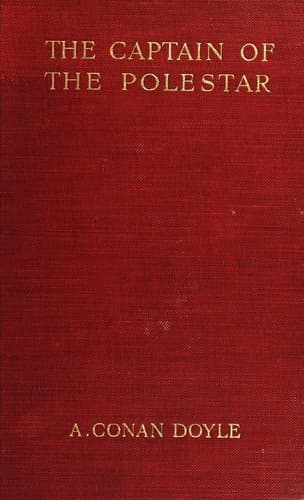
The Captain of the Polestar, and Other TalesDoyle, Arthur Conan
General
The Captain of the Polestar, and Other Tales
Doyle, Arthur Conan
Great Britain -- Social life and customs -- 19th century -- Fiction; Short stories, English
Of all these young devotees of science there was none who equalled
in enthusiasm Fritz von Hartmann. It had often seemed strange to his
fellow-students that wild, reckless Fritz, as dashing a young fellow
as ever hailed from the Rhinelands, should devote the time and trouble
which he did in reading up abstruse works and in assisting the Professor
in his strange experiments. The fact was, however, that Fritz was a
knowing and long-headed fellow. Months before he had lost his heart
to young Elise, the blue-eyed, yellow-haired daughter of the lecturer.
Although he had succeeded in learning from her lips that she was not
indifferent to his suit, he had never dared to announce himself to her
family as a formal suitor. Hence he would have found it a difficult
matter to see his young lady had he not adopted the expedient of making
himself useful to the Professor. By this means he frequently was asked
to the old man’s house, where he willingly submitted to be experimented
upon in any way as long as there was a chance of his receiving one
bright glance from the eyes of Elise or one touch of her little hand.
Young Fritz von Hartmann was a handsome lad enough. There were broad
acres, too, which would descend to him when his father died. To many
he would have seemed an eligible suitor; but Madame frowned upon his
presence in the house, and lectured the Professor at times on his
allowing such a wolf to prowl around their lamb. To tell the truth,
Fritz had an evil name in Keinplatz. Never was there a riot or a duel,
or any other mischief afoot, but the young Rhinelander figured as a
ringleader in it. No one used more free and violent language, no one
drank more, no one played cards more habitually, no one was more idle,
save in the one solitary subject.
No wonder, then, that the good Frau Professorin gathered her Fräulein
under her wing, and resented the attentions of such a _mauvais sujet_. As
to the worthy lecturer, he was too much engrossed by his strange studies
to form an opinion upon the subject one way or the other.
For many years there was one question which had continually obtruded
itself upon his thoughts. All his experiments and his theories turned
upon a single point. A hundred times a day the Professor asked himself
whether it was possible for the human spirit to exist apart from
the body for a time and then to return to it once again. When the
possibility first suggested itself to him his scientific mind had
revolted from it. It clashed too violently with preconceived ideas
and the prejudices of his early training. Gradually, however, as he
proceeded farther and farther along the pathway of original research,
his mind shook off its old fetters and became ready to face any
conclusion which could reconcile the facts. There were many things
which made him believe that it was possible for mind to exist apart
from matter. At last it occurred to him that by a daring and original
experiment the question might be definitely decided.
Public-domain text, read in full here on John Shaqi.
Reviews
Reviews
No reviews yet
Be the first to share your thoughts on this work.
Join the Discussion
Join the discussion
Sign in to leave a comment or review.
Sign InorCreate an account