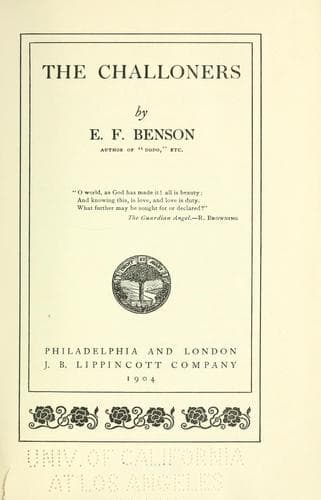
Clergy -- England -- Fiction; England -- Social life and customs -- Fiction; Families -- England -- Fiction
“All Art is perfectly useless.” He remembered having read that sentence
in some book of Martin’s which he had found lying about. A rapid glance
at it on that occasion had justified its confiscation and a few words to
Martin on the subject. But that sentence occurred to him again now, for
there in half a line was expressed tritely and unmistakeably the exact
opposite of what he held to be the truth. All Art, he would have said
himself, that does not--apart from the natural and innocent enjoyment of
it--raise and elevate the soul, is not art at all. As a corollary, the
highest form of painting in his eyes was religious painting, because it
led by a direct road to its goal, the highest form of music, religious
music. These two were wholly laudable; Raphael, so to speak, shook
hands with missionaries, and Handel took Luther’s arm. But at the other
end of the line of artists came those who, however consummate was their
art, treated of themes which in themselves were dangerous, or, worst of
all, who by clothing sin in melodious and beautiful garb rendered it,
even if not attractive, at any rate more venial. He himself, as has been
seen, was not musical; but when a few weeks ago he had found himself in
London with Martin, and with the eminently laudable desire of getting
more into sympathy with his son, had taken him to see “Tannhäuser” at
the opera, the evening had not been wholly a success, for the curtain
had not risen ten minutes on Venusberg before his incredulous horror had
deepened into certainty, and he had got swiftly up and peremptorily
ordered Martin to leave also. And Wagner was hustled by him into the
outer darkness to gnash teeth in company with Zola, George Eliot, and
Titian.
Here, then, is stated in brief, so that the real and soul-searching
difficulty in his course of action with regard to Martin’s future may be
better understood, the attitude of Mr. Challoner towards Art. With the
whole force of his strenuous, upright soul he believed that one thing in
the world alone mattered, and that art, science, knowledge were at the
best but by-paths that led on to the great high-road of the Gospel. In
that they contained many things of beauty the worker was allowed to
wander in their coolnesses at times for the refreshment of his
weariness, but all the beauty he found there was but the sign-post
pointing him back to the high-road. Other by-paths were there also,
beautiful as these, if one looked on the outward form only, but
instinct with danger, and of an evil glitter. Such led through tangled
gardens of vivid meretricious gaudiness, but if one stooped to pluck
those poisonous flowers, they were vitriol to the fingers, and the
unnameable beasts of darkness, coiled among the leaves, alert and ready
to spring, would fasten on the hand.
Public-domain text, read in full here on John Shaqi.
Reviews
Reviews
No reviews yet
Be the first to share your thoughts on this work.
Join the Discussion
Join the discussion
Sign in to leave a comment or review.
Sign InorCreate an account