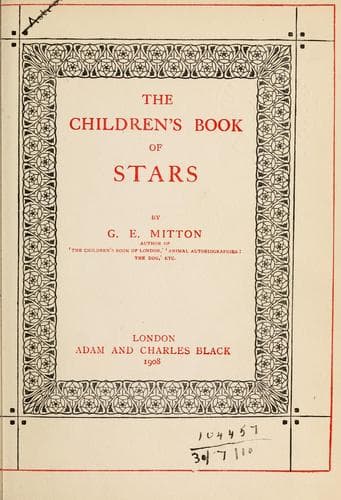
The Children's Book of StarsMitton, G. E. (Geraldine Edith)
Science
The Children's Book of Stars
Mitton, G. E. (Geraldine Edith)
Astronomy -- Juvenile literature
For a long time it was supposed that Mars had no moons, and when Dean
Swift wrote 'Gulliver's Travels' he wanted to make the Laputans do
something very clever, so he described their discovery of two moons
attending Mars, and to make it quite absurd he said that when they
observed these moons they found that one of them went round the planet
in about ten hours. Now, as Mars takes more than twenty-four hours to
rotate, this was considered ridiculous, for no moon known then took
less time to go round its primary world than the primary world took to
turn on its own axis. Our own moon, of course, takes thirty times as
long--that is a month contains thirty days. Then one hundred and fifty
years later this jest of Dean Swift's came true, for two moons were
really discovered revolving round Mars, and one of them does actually
take less time to complete its orbit than the planet does to
rotate--namely, a little more than seven hours! So the absurdity in
'Gulliver's Travels' was a kind of prophecy!
These two moons are very small, the outer one perhaps five or six miles
in diameter, and the inner one about seven; therefore from Mars the
outer one, Deimos, cannot look much more than a brilliant star, and the
inner one would be but a fifth part the apparent width of our own moon.
So Mars is not very well off, after all. Still, there is great variety,
for it must be odd to see the same moon appearing three times in the
day, showing all the different phases as it goes from new to full, even
though it is small!
Such wonderful discoveries have already been made that it is not too
much to say that perhaps some day we may be able to establish some sort
of communication with Mars, and if it be inhabited by any intelligent
beings, we may be able to signal to them; but it is almost impossible
that any contrivance could bridge the gulf of airless space that
separates us, and it is not likely that holiday trips to Mars will ever
become fashionable!
CHAPTER VI
FOUR LARGE WORLDS
I have told you about the four lesser worlds of which our earth is one,
and you know that beyond Mars, the last of them, there lies a vast
space, in which are found the asteroids, those strange small planets
circling near to each other, like a swarm of bees. After this there
comes Jupiter, who is so enormous, so superb in size compared with us,
that he might well serve as the sun of a little system of his own. You
remember that we represented him by a football, while the earth was only
a greengage plum. But Jupiter himself is far less in comparison with the
sun than we are in comparison with him. He differs from the planets we
have heard about up to the present in that he seems to glow with some
heat that he does not receive from the sun. The illumination which makes
him appear as a star to us is, of course, merely reflected sunlight, and
what we see is the external covering, his envelope of cloud.
Public-domain text, read in full here on John Shaqi.
Reviews
Reviews
No reviews yet
Be the first to share your thoughts on this work.
Join the Discussion
Join the discussion
Sign in to leave a comment or review.
Sign InorCreate an account