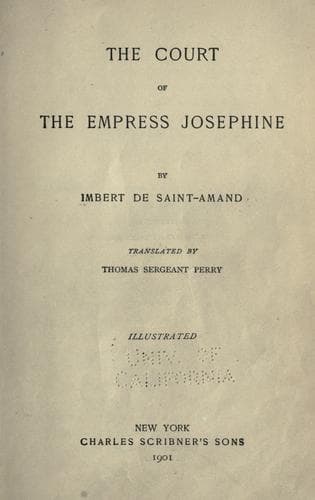
The Court of the Empress JosephineImbert de Saint-Amand
History
The Court of the Empress Josephine
Imbert de Saint-Amand
Josephine, Empress, consort of Napoleon I, Emperor of the French, 1763-1814
The Grand Equerry looked after the stables, the pages, the couriers, and
the Emperor's arms; he also had the supervision of the horses at Saint
Cloud. He walked just before the Emperor when he came forth from his rooms
to ride, gave him his whip, held his reins and the left stirrup. He was
responsible for the good condition of the carriages, the intelligence and
skill of the huntsmen, coachman, and the postilions, the safety and the
training of the horses. In a procession, or on a journey, he was in the
carriage just before the Emperor's. He accompanied the Emperor to the
army, if the sovereign's horse was killed or disabled, it was his duty to
pick the Emperor up and to offer him his own horse.
The Grand Equerry had four equerries under his orders: Colonels Durosnel,
Defrance, Lefebvre, Vatier, and two equerries in ordinary, M. de Canisy
and M. de Villoutrey. An equerry on duty always accompanied the Emperor,
whether he was driving or riding. If the Emperor drove, the equerry on
duty rode by the right-hand door of the carriage, unless the colonel-
general on duty happened to be on horseback, in which case the equerry
rode on the other side. The equerry on duty walked before the Emperor when
he left or returned to his apartment; he never left the waiting-room
during the day, and slept in the palace.
The pages, whose governor was General Gardane, were also under the orders
of the Grand Equerry. They were appointed when between fourteen and
sixteen, and held the position until they were eighteen. At grand dinners
and in the apartments of honor, they waited on the Emperor and Empress,
and on the Princes and Princesses. When the Emperor rode out, one followed
on horseback; if he drove, the page got up behind the carriage. When the
sovereign went forth in his state-coach, as many pages as possible
clambered up behind it and upon the box by the side of the coachman. At
receptions, and on days when mass was said, there were eight pages on
duty. They stood in a row when the Emperor returned to his apartment, and
walked before him when he left it. If the Emperor had not returned to the
palace by nightfall, the pages would wait at the entrance-door to walk
before him, carrying lights. The pages, too, served as messengers, and
when they carried letters of the Emperor, the doors were thrown wide open
before them.
Public-domain text, read in full here on John Shaqi.
Reviews
Reviews
No reviews yet
Be the first to share your thoughts on this work.
Join the Discussion
Join the discussion
Sign in to leave a comment or review.
Sign InorCreate an account