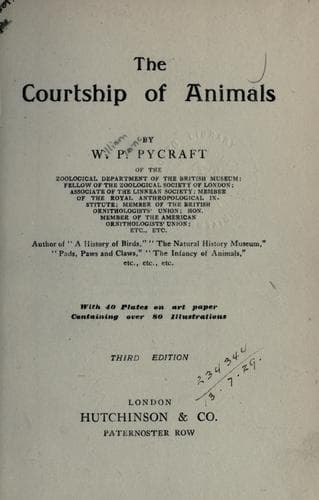
The Courtship of AnimalsPycraft, W. P. (William Plane)
Science
The Courtship of Animals
Pycraft, W. P. (William Plane)
Animal behavior; Natural selection
It cannot be supposed that these quaint performances are peculiar to
the species in which they have been observed, but rather it may be
inferred that similar antics, besides others yet to be discovered,
are performed by all. Their purpose seems plain enough, for they must
be regarded surely as aphrodisiacs, excitants to pairing. They recall
the erotic dances of savages, or the ceremonial orgies of ancient
civilizations. Such performances, on an even more elaborate scale, are
to be met with among the birds.
So far, in describing the horned ruminants, the horns only have been
considered; but these animals display yet other secondary sexual
characters, which, while less conspicuous, are yet no less important
during this critical period of life. Some, as for instance the canine
teeth possessed by some of the deer, are decidedly puzzling. While
absent, or vestigial, in most, in a few they are greatly developed, and
this, too, in species which possess relatively large horns, as in the
Muntjac. It seems difficult to believe that the co-existence of these
very different kinds of weapons can be of vital importance to their
possessors; yet unless this be so, one or other would surely have
degenerated. It is significant that in the hornless Musk-deer these
teeth attain to a very considerable length, at their maximum as much
as three inches. That they are used by rival males, and with effect,
is shown by the fact that the hides of these animals are often found
scored by deep lines cut by these tusks. In those aberrant ruminants,
the Camels, quite formidable tusks are present both in the upper and
lower jaws, and these are used with effect whenever occasion demands,
and often when it does not.
The armoury necessary for successful love-making contains yet other
weapons, evolved to supplement physical force, and more subtle in their
effect. Such are certain skin glands which, at the rutting season,
secrete a copious flow of a creamy, or semi-fluid matter, and pungent
odour. In the deer the more important of these are found in the deep
pit, or “larmier,” which opens in front of the eye. In the Musk-deer,
however, this secretion has a most powerful odour of musk, and is
formed in a pouch, or “pod,” of about the size of a small orange, under
the skin of the abdomen. The secretion, which is formed by the male
only, is of a chocolate colour, and of about the consistence of moist
gingerbread. It has a most pungent scent, and when diluted forms the
basis of many of our most powerful and most highly-prized perfumes, on
which account, it may be mentioned, this animal has for generations
been submitted to a most unrelenting persecution. But that is another
story.
Public-domain text, read in full here on John Shaqi.
Reviews
Reviews
No reviews yet
Be the first to share your thoughts on this work.
Join the Discussion
Join the discussion
Sign in to leave a comment or review.
Sign InorCreate an account