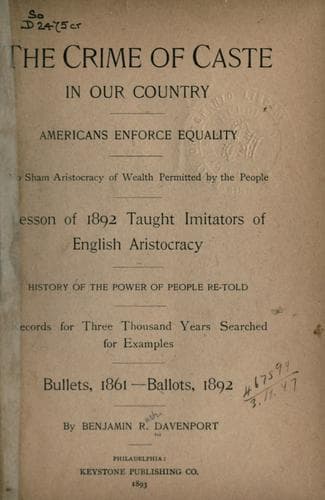
The Crime of Caste in Our CountryDavenport, Benjamin Rush
History
The Crime of Caste in Our Country
Davenport, Benjamin Rush
Social problems; United States -- Social conditions -- 1865-1918
“‘Well, perhaps so,’ he replied. ‘It is hard for a man who is not
a political economist and who doesn’t make a business of keeping
track of such things to give any reason for the hard times, or to
choose between the reasons given by Democrats and Republicans.
So far as I know, the Republican party has always kept its
promises made to the farmers. Since the McKinley tariff we have
been getting better prices for our potatoes and other produce in
Northern New York, for before, we had not been able to compete
with Canada. Yet, we don’t make much of a living, even at this.
You say that statistics prove that this country, as a Nation, is
vastly more prosperous than any other, and that we are a good deal
richer than we were ten years ago; yet I am not any better off,
and most of the farmers around here are not any better off, and
I made up my mind that if, as the Democrats promise, a change of
Administration would make good times, why, I wanted a change; if
Free Trade will make things better, I want Free Trade; if State
banks will give us money, and more of it, I want State banks put
on equal terms with National banks. If these changes are brought
about, it may make things a good deal worse than they are now. At
any rate, I am willing to try it. If I find that the Democrats
have deceived me, in 1896 I shall vote the Republican ticket
again.’
“These interviews show the state of mind among people who are
enough in number to turn overwhelmingly a majority for either the
Republican or the Democratic party. In them is ample evidence
that the people whose votes defeated the Republican party are
not dissatisfied with Republican administration of affairs. They
do not charge that the McKinley bill, or that the financial
or any other Republican policy is responsible for hard times,
nor is there any testimony which can be taken as evidence that
the ‘unbounded popularity’ of Grover Cleveland or the (by the
Democrats so called) broad financial and economic policy of that
party, has brought about this sweeping victory. A talk with the
independent voter shows, first, that there exists among the
smaller tradesmen, among those whose votes turn the tide toward
victory or toward defeat, dissatisfaction because, as they claim,
they are unable to compete with combinations of capital; they want
decentralization of capital, and trusts prohibited by law and the
law enforced.
Public-domain text, read in full here on John Shaqi.
Reviews
Reviews
No reviews yet
Be the first to share your thoughts on this work.
Join the Discussion
Join the discussion
Sign in to leave a comment or review.
Sign InorCreate an account