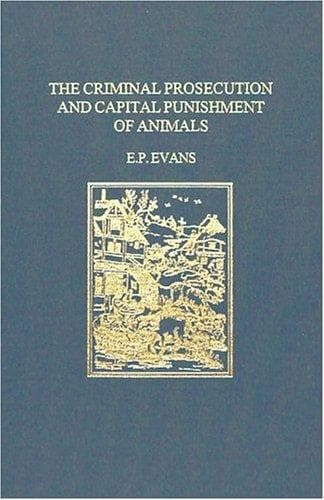
The Criminal Prosecution and Capital Punishment of AnimalsEvans, E. P. (Edward Payson)
History
The Criminal Prosecution and Capital Punishment of Animals
Evans, E. P. (Edward Payson)
Animals -- Law and legislation -- History; Animals, Prosecution and punishment of -- History; Trials -- Europe
Origen held that the scheme of redemption embraced also Satan and his
satellites, who would be ultimately converted and restored to their
primitive estate. Several patristic theologians endorsed this notion, but
the Church rejected it as heretical. The devils are, therefore, from the
standpoint of Catholic orthodoxy, irrevocably damned and the blood of
Christ has made no atonement for them. But, although their fate is sealed
their torments have not yet begun. If a man dies in his sins, his soul, as
soon as it departs from his body, receives its sentence and goes straight
to hell. The highest ecclesiastical authorities have decided that this is
not true of devils, who, although condemned to everlasting fire, do not
enter upon their punishment until after the judgment-day. This view is
supported by many passages and incidents of Holy Writ. Thus Christ
declares that, when the Son of man shall come in his glory, he shall say
unto them on his left hand, “Depart from me, ye cursed, into everlasting
fire prepared for the devil and his angels.” Here it is not stated that
the devils are already burning, but that the fire has been “prepared” for
them, a form of expression which leads us to infer that they were not yet
in it. Again the devils, which Christ drove out of the two “exceeding
fierce” demoniacs, protested against such interference, saying, “Art thou
come hither to torment us before the time?” This question has no
significance, unless we suppose that they had a right to inhabit such
living beings as had been assigned to them, until the time of their
torment should come on the last day. Père Bougeant is furthermore of the
opinion that, when these devils were sent miraculously and therefore
abnormally into the swine, they came into conflict with the devils already
in possession of the pigs, and thus caused the whole herd to run violently
down a steep place into the sea. Even a hog, he thinks, could not stand it
to harbour more than one devil at a time, and would be driven to suicide
by having an intrinsic and superfluous demon conjured into it. A still
more explicit and decisive declaration on this point is found in the
Epistle of Jude and the Second Epistle of Peter, where it is stated that
the angels which kept not their first estate the Lord hath reserved in
everlasting chains under darkness unto the judgment of the great day.
These words are to be understood figuratively as referring to the
irrevocableness of their doom and the durance vile to which they are
meanwhile subjected. That they are held in some sort of temporary custody
and are not actually undergoing, but still awaiting the punishment, which
divine justice has imposed upon them, the sacred scriptures and the
teachings of the Church leave no manner of doubt.
Public-domain text, read in full here on John Shaqi.
Reviews
Reviews
No reviews yet
Be the first to share your thoughts on this work.
Join the Discussion
Join the discussion
Sign in to leave a comment or review.
Sign InorCreate an account