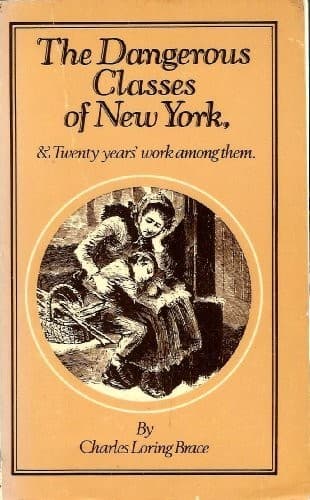
The Dangerous Classes of New York, and Twenty Years' Work Among Them — John Shaqi
The Dangerous Classes of New York, and Twenty Years' Work Among ThemBrace, Charles Loring
History
The Dangerous Classes of New York, and Twenty Years' Work Among Them
Brace, Charles Loring
Child welfare -- New York (State) -- New York; New York (N.Y.) -- Social conditions; Poor -- New York (State) -- New York
But admitting that we cannot entirely prevent the enormous massing of
people, such as prevails in our Eleventh and Seventeenth Wards, we can
certainly control it by legislation. The recent Sanitary Acts of New
York attempt to hold in check the mode of building tenement-houses,
requiring certain means of ventilation and exit, forbidding the
filling-up of the entire space between the houses with dwellings, and
otherwise seeking to improve the condition of such tenement-houses.
There only needs two steps farther in imitation of the British
Lodging-house Acts--one removing altogether the cellar-population, when
under certain unhealthy conditions; and the other limiting by law the
number who can occupy a given space in a tenement-room. The British Acts
assign 240 cubic feet as the lowest space admissible for each tenant or
lodger, and if the inspector finds less space than that occupied, he at
once enters a complaint, and the owner or landlord is obliged to reduce
the number of his occupants, under strict penalties. A provision of this
nature in our New York law would break up our worst dens, and scatter
their tenants or lodgers. The removal of the cellar-population from a
large proportion of their dwellings should also be made. Liverpool
removed 20,000 cellar-occupants in one year (1847), to the immense gain,
both moral and sanitary, of the city. New York needs the reform quite as
much. There would be no real hardship in such a measure, as the tenants
could find accommodations in other parts of the city or the suburbs; and
some would perhaps emigrate to the country.
One often-proposed remedy for the ills of our tenement-house system--the
"Model Lodging-house"--has never been fairly tried here. The theory of
this agency of reform is, that if a tenement-house can be constructed on
the best sanitary principles, with good ventilation, with limited number
of tenants, no overcrowding, and certain important conveniences to the
lodgers, all under moral supervision (so that tenants of notoriously bad
character are excluded), and such a house can be shown to pay, say seven
per cent. net, this will become a "model" to the builders of
tenement-houses; some building after the same style, because public
opinion and their own conscience require it, others because competition
compels it. Thus, in time, the mode of structure and occupancy of all
the new tenement-houses would be changed. But to attain this desirable
end, the model houses must first pay a profit, and a fair one. So long
as they do not succeed in this, they are a failure, however benevolent
their object and comfortable their arrangements. In this point of view,
the "Waterloo Houses," in London, are a success, and do undoubtedly
influence the mode of building and management of private
tenement-houses; in this, also, the "Peabody Houses" are not a success,
and will have no permanent influence.
Public-domain text, read in full here on John Shaqi.
Reviews
Reviews
No reviews yet
Be the first to share your thoughts on this work.
Join the Discussion
Join the discussion
Sign in to leave a comment or review.
Sign InorCreate an account