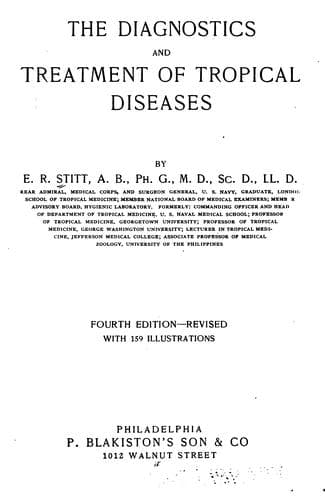
The diagnostics and treatment of tropical diseasesStitt, E. R. (Edward Rhodes)
Science
The diagnostics and treatment of tropical diseases
Stitt, E. R. (Edward Rhodes)
Tropical medicine
_Bilious Remittent Fever._—This is the most common and the least
dangerous of the pernicious manifestations but tends rapidly to
produce malarial cachexia. Slight jaundice and bilious vomiting
may appear in the course of an ordinary malignant tertian paroxysm
and only severe types, with fatal tendency, should be classed as
pernicious. It sets in with marked nausea followed by bilious
vomiting and bile-rich stools. Jaundice shows itself by the second
day; earlier than in yellow fever, but much later than the rapidly
appearing jaundice of blackwater fever. The urine shows bile pigment
and a yellow foam. Epigastric distress and liver tenderness are
marked features and there may even be gastric haemorrhage.
_Pneumonic and Cardiac Types._—Other recognized types are when,
with the symptoms of a broncho-pneumonia, we find an element of
periodicity and a response to quinine—the so-called pneumonic
type.
Again, usually in elevated regions, dilatation of the right
heart and death have been noted as occurring in cardiac types of
pernicious malaria.
Another type is one in which the sweating stage is excessive, the
so-called diaphoretic type. These cases may result in collapse and
such a termination may be syncopal in character.
=Relapses.=—Relapses are distinct features of malarial diseases,
the tendency being most marked in quartan and least so in malignant
tertian. A relapse after an interval of two years is very rare in
malignant tertian but periods as long as nine years may intervene
between attacks of quartan fever.
Relapses are intimately associated with conditions which tend to
lower the body resistance, so that exposure to cold or wet or
hot sun may bring on an attack. Alcoholic or venereal excesses,
as well as errors of diet, may be provocative. Persons returning
home from the tropics often experience relapses as they approach
the cooler climate of the temperate zone. It has been well stated
that the old resident of the tropics owes his condition of health
rather to education than acclimatization—experience has taught him
discretion.
There are three explanations of relapses of which the one supported
by Ross and Bignami seems more reasonable and is that the
disappearance of nonsexual parasites is only apparent and that they
continue their cycle but in insufficient numbers to excite symptoms.
_Parthenogenesis._—Schaudinn thought that, either spontaneously
or as the result of treatment, there was a disappearance of the
nonsexual forms and the male gametes, the female gametes however
surviving and, eventually, through the process of parthenogenesis,
producing a set of spores or merozoites which set up a nonsexual
cycle. It would seem probable that Schaudinn saw red cells
containing a merozoite along with a female gamete and interpreted
his findings as a sporulating sexual form.
Public-domain text, read in full here on John Shaqi.
Reviews
Reviews
No reviews yet
Be the first to share your thoughts on this work.
Join the Discussion
Join the discussion
Sign in to leave a comment or review.
Sign InorCreate an account